
The Synergy of Knowledge Graphs and Agentic AI: Achieving Connected Intelligence and Actionable Autonomy
By Faizan Javed, Ph.D., Sr. Director – Data Science & Engineering, Kaiser Permanente
Introduction
Artificial Intelligence (AI) has evolved from a boardroom curiosity into a dominant economic engine, driven by massive global investment as most enterprises now integrate AI into their core operations. This rapid adoption is no longer about simple automation; it is a fundamental shift in how businesses drive ROI and productivity, moving past pilots into full-scale production. The emergence of Actionable Autonomy, when Agentic AI goes beyond basic content creation to reason and carry out intricate, multi-step workflows, is what defines this change. To ensure these systems operate reliably in high-stakes environments, they are anchored by Connected Intelligence via Knowledge Graphs (KG), which provide a unified source of truth to eliminate the hallucinations inherent in generative models.
Knowledge Graphs: Connected Intelligence
An ontology is a semantic model that defines entities, and the relationships allowed between them. A knowledge graph is a connected network of data organized according to an ontology.
KGs enable AI to answer sophisticated, multi-dimensional user queries such as “Find a pediatrician near me who is in-network for my plan and has an opening this Friday” with high precision. As a unified source of truth, KGs streamline downstream applications while eliminating engineering silos. By consolidating data analytics into a single framework, KGs reduce operational redundancy and accelerate the generation of organization-wide insights.
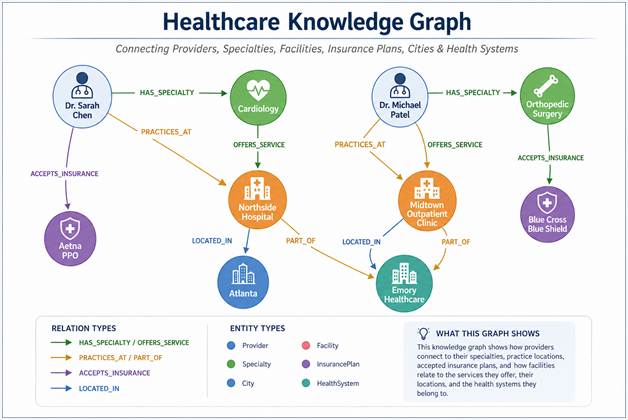
Figure 1 shows a hypothetical healthcare knowledge graph with entities such as provider (healthcare professional), specialty and facility and relations such as has_specialty and practices_at. It has facts such as Dr. Sarah Chen practices at Northside Hospital, which is located in Atlanta, from which it can be inferred that Dr. Sarah Chen is based in Atlanta. Hence, KGs can derive new facts and relationships that were never directly stored, enabling smarter search, recommendations, and decision support.
The combination of Knowledge Graphs and Agentic AI creates a foundation for trustworthy, enterprise-scale AI
Agentic AI: Actionable Autonomy
While Generative AI (like basic ChatGPT) is reactive—it waits for a prompt and generates content—Agentic AI is proactive. Agentic AI refers to systems designed to act as autonomous agents. Instead of just answering a question (like a standard chatbot), an agentic system can plan, use tools (such as APIs and databases), and execute a series of steps to achieve a goal.
The functional core of Actionable Autonomy is defined by a triad of capabilities: Perception, Reasoning, and Action. Through Perception, an agent observes and interprets environmental signals and real-time data, providing the context necessary for the Reasoning phase, where broad business objectives are decomposed into a logical sequence of sub-tasks. This cycle ends with Action, when the agent independently carries out these actions by interacting with legacy software, APIs, or other systems, successfully converting strategic intent into observable operational results.
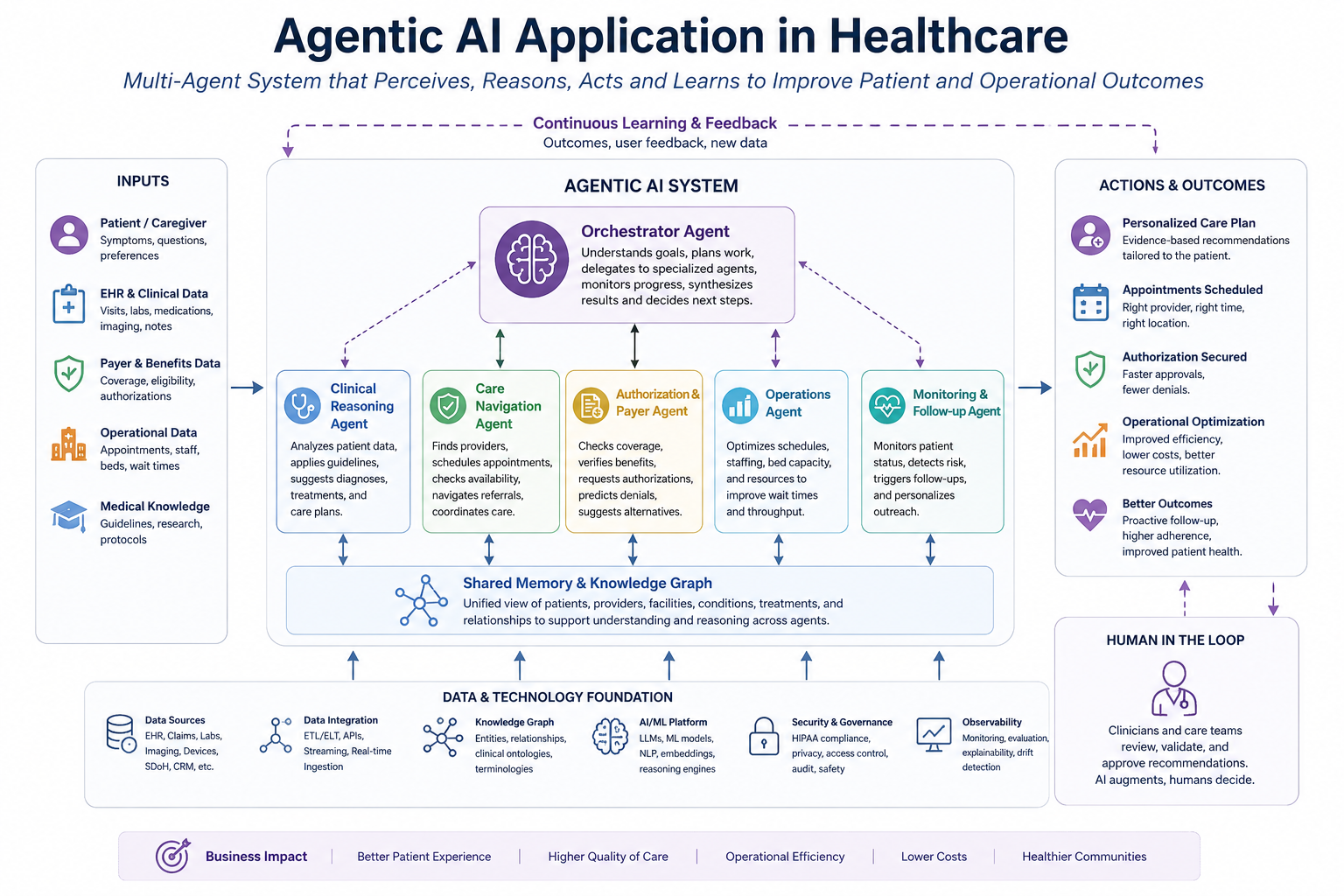
Figure 2 shows an example of a healthcare agentic AI system. A patient reporting chest pain triggers a workflow where the orchestrator agent coordinates multiple specialized AI agents across clinical, operational, and administrative domains. Clinical agents assess medical risk, the knowledge graph identifies the best in-network providers and facilities, navigation agents schedule care, payer agents handle insurance verification and authorization, and operations agents optimize scheduling and resources — all while clinicians maintain oversight of final decisions. The system acts as a coordinated digital healthcare team that proactively manages the patient journey end-to-end to improve outcomes, efficiency, and care coordination.
How Knowledge Graphs can empower Agentic AI
Particularly in complicated, regulated, and high-stakes situations, KGs can help Agentic AI systems reason more consistently, plan more efficiently, and behave responsibly.
KGs can improve agent performance in the following ways:
- Grounding & hallucination control: KGs can serve as a verified source of truth, constraining outputs to factual entities and relationships rather than probabilistic guesses.
- Advanced reasoning (GraphRAG): Retrieval-Augmented Generation (RAG) enhances an agent’s ability to produce accurate, context-aware outputs by retrieving relevant external information before generating a response. However, RAG often struggles with complex queries that require connecting disparate pieces of information. KGs enable GraphRAG, which allows multi-hop traversal across connected data, allowing agents to answer complex queries that require linking multiple steps or domains. While a query like “What is the capital of the USA?” can be answered by retrieving a single stored fact, a query like “Which airline has the largest hub at the busiest airport in the world?” requires an agent to traverse a chain of relationships.
- Better planning: KGs can encode domain structure and relationships, helping agents break down goals into coherent, rule-aware sequences of actions. This results in better sequencing of tasks and decisions that align more closely with enterprise policies and outcomes
- Explainability & compliance: Because a KG is structured, the path an agent takes to conclude is fully auditable. Every decision path can be traced and audited, supporting transparency in regulated settings.
- Smarter tool use: By modeling APIs and tools as graph entities with capabilities and constraints, KGs can help agents choose the right action in context.
How Agentic AI can empower Knowledge Graphs
Agentic AI can complement KGs by acting as the operational layer that continuously builds, improves, and maintains enterprise knowledge at scale. Rather than simply consuming information, agents can actively curate and enrich the graph ecosystem.
Agentic AI can improve KGs in the following ways:
- Automated graph creation: Agents can extract entities and relationships from large volumes of unstructured data, rapidly expanding and updating the graph.
- Data quality and entity resolution: Agents can continuously validate, reconcile, and correct graph data to improve accuracy and consistency. They can perform complex entity resolution—such as determining if two similar entries represent the same facility or provider—by reasoning across multiple attributes
- Real-time enrichment: They can monitor external signals like regulations or research updates and automatically update relevant graph relationships and attributes.
- Natural language access: Agents can translate human language into graph queries, making complex graph intelligence accessible without specialized technical skills.
Conclusion
The combination of Knowledge Graphs and Agentic AI creates a foundation for trustworthy, enterprise-scale AI. KGs provide structured, connected intelligence that grounds AI reasoning, reduces hallucinations, enables complex multi-step reasoning, and supports explainable decision-making. In turn, Agentic AI continuously enriches, validates, and updates the graph in real time, keeping the knowledge base accurate and actionable. Together, they bridge the gap between generative AI flexibility and enterprise-grade precision, enabling scalable, reliable, and compliant AI systems.