
Governance Is How You Earn the Right to Move Fast
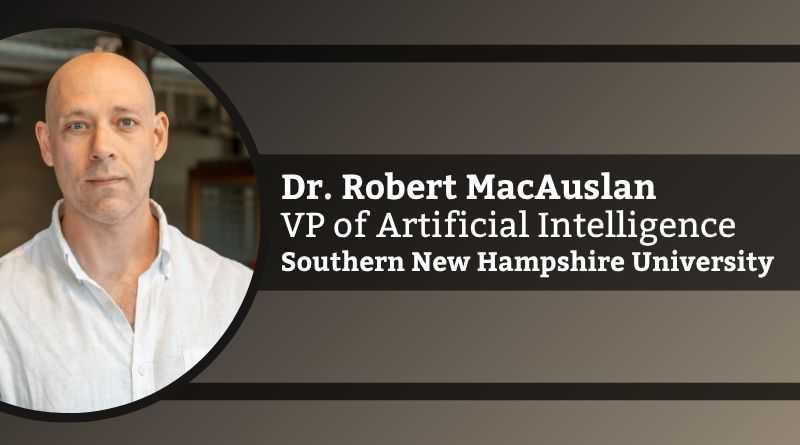
By Dr. Robert MacAuslan, VP of Artificial Intelligence, Southern New Hampshire University
“Should I be using this?” A staff member asked me about a particular AI tool in the fall of 2023, and it has stayed with me because it was really two questions in one, both equally important but distinct. One was about permission: am I allowed, is there a policy, will I get in trouble? The other was about conscience: is this right, is it fair, is it something I want to be part of? Both are questions about trust. Getting the answers right matters as much as getting the technology right.
I heard that question because we had gone looking. My team and I spent that fall sitting with departments across the institution, not to sell anyone on AI but to understand what was getting in their way. This was not an exercise in evangelism. I am a self-described practical skeptic about AI: persuaded it can do real work, and clear-eyed about what comes with it, the environmental cost of training and running these models, the bias they inherit from the data they were built on, the ease with which they get sold as a fix for problems no one has defined yet. That awareness sharpens the skepticism, and it is why I will not put a tool in front of students or staff blindly. We asked teams about their real problems, because you earn the right to offer a solution only after you understand the work. AI came up on its own, almost everywhere, and it came wrapped in that same hesitation. People frequently expressed their desire for it and their lack of trust in it at the same time.
That mix of desire and mistrust was not evenly distributed. Some teams were eager, others reticent, and the eagerness clustered in particular corners. Our Learning Science teams wanted help designing and editing courses. Data Analytics saw work that could move faster. Marketing was already experimenting. This matters at an academic institution like ours, where the full-time workforce is 97% staff rather than faculty. Adoption here was always going to be staff-led, and the staff were ready.
The hesitation was just as real, and it took many forms. Some of it was practical and personal: will this replace my job, is my data safe, is the output accurate enough for the analysis I rely on, is it safe and unbiased enough to put in front of a student? Some of it went deeper, less about any single job than about whether we should be doing this at all. People raised the very concerns that inform my own skepticism, the environmental toll chief among them, and added others I take just as seriously: the privacy of the data these tools consume, and the prospect that a technology sold as assistance becomes a rationale for cutting people. Some of these questions do not have clean answers, and it is a mistake to wave them off.
If anything, that second kind of doubt is more pronounced now than it was then. Over the past six months, anti-AI sentiment in the United States has grown louder and better organized, and I have seen the same shift inside our own institution. The people who hesitated in 2023 were early. Whatever you make of where they landed, they were asking the right questions, and the questions have not gone away.
There is a version of AI adoption that looks impressive early and is fragile underneath: tools everywhere, dashboards full of motion
What I came to understand is that adoption turns on trust. Eagerness alone does not make it work. It works when people can trust the tools, and when they can trust the institution putting those tools in front of them. That, more than raw capability, is what determines how effectively an organization adopts AI. And trust has to be earned in more than one way: in the tool, that it is accurate, safe, and fair; in the training that prepares people to use it; in the judgment of the people who deployed it; and in the institution itself, to hold to its mission and values.
That puts a leader in a difficult position, especially in an organization with a real appetite. The people who want to use AI will use it, sanctioned or not. When there is no approved path, they make their own. They paste sensitive information into whatever consumer tool is open in the browser. They build workarounds no one has reviewed. This is shadow AI, and it confirms the skeptics’ fears faster than anything else could. The people who hesitated, meanwhile, stay out entirely, their questions unanswered. You are left with two failures at once: adoption no one can trust, and people who will not adopt at all.
The way through is not more enthusiasm. It is governance, arriving first. I do not mean a committee that says no. I mean building the channel before the appetite turns into a flood, so that the people who want it have a fast and legitimate path, and the people who doubt it get real answers. For us, that meant three things, running at once.
The first was literacy, and it came in two kinds. One was mandatory: a security training that everyone completed, skeptics and holdouts included. My team developed it together with our information security team. It covered what a person needs to know to stay safe: what these systems do with data, where they fail, and what not to put into them. It was never a tutorial on any one tool. We did not require anyone to use AI. We required them to understand it. The overwhelming majority of our full-time staff have now completed that training, and the number was never the point. You cannot ask people to use AI responsibly, or even to decide they would rather not, until they know what they are dealing with. The second kind was optional and hands-on: workshops for people who wanted to put the tools to use in their work, going as deep as they cared to.
The second was a real path for experimentation, and it grew directly out of our partnership with ITS. It began as a working relationship between me and our chief technology officer, and it could not have happened without genuine trust between the AI team and ITS. Together, we built a structured intake where anyone with an idea could bring it forward, and every request ran through a security and bias review before it reached our ecosystem. This directly answered two of the questions we heard on the tour: is my data safe and is this accurate and fair. Just as important, the path was worth taking. Ideas moved through it, and what came out was a vetted tool people could trust and use openly. A workaround offered none of that. That is the part most institutions miss. Shadow AI does not shrink because you forbid it. It shrinks when the sanctioned route is the one people would rather use.
The third was the discipline to stop. Not every tool we tested was worth keeping, and when one was not, we said so and shut it down. In an organization eager to move, that is harder than it sounds, because stopping disappoints the people who were excited about it. But the tools we chose not to scale never spread, never had to be walked back, and never proved the skeptics right. Stopping is a win. It may be the clearest proof that governance is more than a formality.
The obvious objection is that all of this slows you down. In my experience, it is the opposite. When we started, the time it took to evaluate a request and reach a decision was measured in weeks. As the process matured, and as we worked with ITS to streamline the intake itself, that time fell by roughly three quarters. Part of that was discipline on our side; part of it was teams learning to bring us better-scoped ideas. Governance did not slow us down. We can move quickly now precisely because people across the institution trust that anything reaching them has already been vetted. Cutting that work out does not make you faster. It defers the cost. The first time a tool fails in public, in front of students, staff, or the board, you forfeit the trust you had built, and winning it back is slow work.
There is a version of AI adoption that looks impressive early and is fragile underneath: tools everywhere, dashboards full of motion. The other version moves more deliberately, and ends up further ahead, because each piece builds on the last. Every vetted tool, every trained employee, every documented decision to adopt or to stop becomes infrastructure on which the next decision rests on. We are not starting from zero each time an opportunity appears. That, more than any single deployment, is the real asset.
So here is what I would offer any executive responsible for AI strategy and adoption. Whatever level of enthusiasm you are starting from, the task is the same: earn trust before you scale, not after. That means training people, giving them a path better than the workaround, and being willing to walk away from a poor fit.
The staff member who asked whether she should be using this deserved a straight answer. So does everyone who asks after her. Earning the right to answer them is the work, and it does not end.
Dr. Robert MacAuslan is Vice President of Artificial Intelligence at Southern New Hampshire University. The work described here is the product of SNHU’s AI team, in partnership with our colleagues in ITS.