

From Intelligent Automation to Adaptive Operations: The Role of Physical AI in Elevating Supply Chain Solution Development
By Dr. Anand Nayyar, Full Professor, Scientist, Vice-Chairman (Research) and Director (IoT and Intelligent Systems Lab), Duy Tan University and Dr. Magesh Kasthuri, Chief Architect and Distinguished Member of Technical Staff
Supply chains have always been physical systems first and digital systems second. Goods move through factories, warehouses, cold rooms, vehicles, ports, stores, hospitals, and customer locations; every delay, defect, temperature excursion, stockout, idle machine, unsafe movement, and manual handoff leaves a tangible operational footprint. For many years, digital transformation focused mainly on planning systems, enterprise resource planning, warehouse management, transport management, analytics dashboards, and supply chain control towers. These tools improved visibility and decision-making, but they often stopped short of directly influencing the physical world where supply chain performance is ultimately won or lost.
Physical AI changes this equation. It brings artificial intelligence into machines, assets, facilities, and field operations so that systems can sense what is happening, interpret the situation, decide on the right action, and execute safely through robotics, automation, connected equipment, edge devices, and human-guided workflows. In the context of supply chain solution development, Physical AI is not simply another automation layer. It is the bridge between computational intelligence and operational action, connecting predictive models, digital twins, computer vision, autonomous mobile robots, collaborative robots, industrial IoT, control systems, and agentic decision engines into a live operating fabric.
- Understanding Physical AI in the Supply Chain Context
Physical AI can be described as the application of AI to systems that operate in the real world, where perception, reasoning, movement, safety, and timing matter. A demand forecasting model may predict next month’s demand, but a Physical AI system may guide how pallets are repositioned in a warehouse, how a robotic arm handles fragile medical vials, how a production line adjusts to quality deviations, or how an autonomous vehicle reroutes materials inside a plant. The distinction is important: Physical AI is action-oriented and environment-aware.
In supply chain solution development, Physical AI typically appears where digital decisions must be translated into operational execution. It may support automated receiving, computer vision-based quality checks, real-time cold-chain monitoring, robotic picking, autonomous material movement, adaptive production scheduling, smart shelf monitoring, predictive maintenance, dynamic route orchestration, and closed-loop replenishment. Its value lies in reducing the distance between insight and action. Instead of waiting for a human operator to read an alert, interpret a dashboard, and manually intervene, Physical AI enables systems to act within defined guardrails while maintaining human supervisory control. - Evolution of Physical AI: From Fixed Automation to Embodied Intelligence
The evolution of Physical AI can be understood through four broad phases. The first phase was fixed automation, in which machines followed preprogrammed instructions in predictable settings. Conveyor belts, automated storage systems, programmable logic controllers, barcode scanners, and industrial robots improved speed and consistency but lacked adaptability. Their operating environment had to be carefully controlled, and even small changes in product shape, packaging, lighting, layout, or process sequence could require reconfiguration.
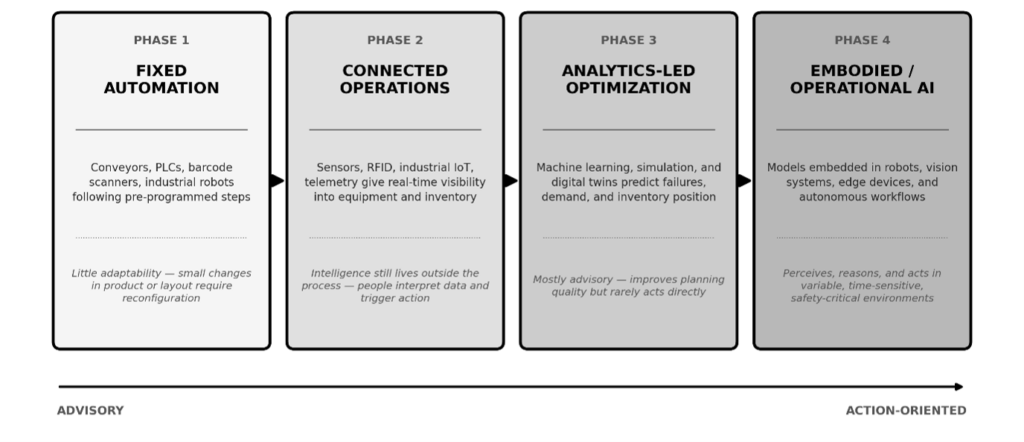
The second phase introduced connected operations. Sensors, RFID, industrial IoT, and telemetry platforms allowed enterprises to observe equipment, inventory, and vehicle movements in near real time. This was a major step forward because operational data became visible beyond plant floors and warehouses. Nonetheless, a large portion of intelligence continued to exist outside of the physical process. People had to interpret the data and then trigger corrective action.
The third phase was analytics-led optimization. Machine learning, simulation, and digital twins began to predict failures, estimate demand, recommend inventory positions, and test operational scenarios. These capabilities improved planning quality, but many deployments still remained advisory in nature. The final and current phase is embodied or operational AI, where models are embedded into robots, vision systems, edge devices, control systems, and autonomous workflows. This allows AI to perceive, reason, and act in environments that are variable, time-sensitive, and safety-critical.
Physical AI represents a decisive step in the evolution of supply chain technology. It moves enterprises beyond passive visibility and analytical recommendations toward adaptive, real-time, physically aware operations.
- Recent Trends Shaping Physical AI in Supply Chains
Several recent trends are accelerating the adoption of Physical AI. First, robots are becoming more flexible. Traditional industrial robots were excellent at repetitive tasks, but newer systems combine vision, force sensing, learning-based motion planning, and natural-language configuration. This enables robots to handle greater product variability and move from single-purpose automation toward polyfunctional roles across picking, packing, inspection, palletizing, machine tending, and replenishment.
Second, edge AI is becoming more practical. Supply chain environments cannot always wait for cloud round trips, especially where motion control, safety, quality inspection, or cold-chain excursions require fast response. Edge inference allows cameras, sensors, gateways, and robots to make local decisions while synchronizing higher-level insights with cloud platforms and enterprise systems. This improves latency, resilience, and data privacy.
Third, digital twins are moving from visualization to operational simulation. A warehouse twin can test slotting strategies before physical rearrangement. A plant twin can simulate throughput under equipment constraints. A cold-chain twin can predict risk exposure across routes, packaging conditions, ambient temperature, and dwell time. When these twins are connected with Physical AI systems, simulation does not remain a planning exercise; it becomes part of a continuous improvement loop.
Fourth, agentic AI is beginning to complement Physical AI. Software agents can monitor inventory, supplier status, logistics constraints, production schedules, and service-level commitments. Physical AI systems can then execute approved actions through robotic workflows, facility automation, or operator-guided tasks. This combination creates a more adaptive supply chain, but it also requires robust governance because autonomous recommendations and physical execution introduce operational, safety, and compliance risks. - Cost Implications in Large-Scale Physical AI Implementation
The cost profile of Physical AI is different from that of software-only AI. Large-scale deployments require investment in sensors, cameras, robotics, edge compute, connectivity, safety systems, integration middleware, simulation environments, data platforms, cybersecurity controls, change management, and ongoing maintenance. The total cost is therefore not limited to model development or cloud consumption. It includes the cost of making the physical environment AI-ready.
A practical cost model should separate expenses into five categories. The first is infrastructure cost, covering cameras, RFID, sensors, gateways, robotics, autonomous mobile robots, machine controllers, private 5G or Wi-Fi enhancements, and ruggedized edge devices. The second is data and platform cost, including data ingestion, storage, labeling, model training, MLOps, simulation engines, and integration with ERP, SCM, WMS, TMS, MES, QMS, and supplier systems. The third is engineering and integration cost, often significant because physical environments vary by site, process, product type, safety layout, and legacy equipment. Monitoring, model retraining, spare parts, robot maintenance, battery management, vendor support, and cyber updates are all included in the fourth category of running costs. The fifth is organizational cost, including process redesign, operator training, safety certification, governance, and adoption management.
The business case becomes stronger when implementation is phased around measurable operational outcomes. Suitable starting points are use cases with repeatable tasks, visible pain points, measurable baselines, and limited process ambiguity. Examples include vision-based quality inspection, automated inventory counting, cold-chain monitoring, robotic pallet movement, predictive maintenance, and warehouse slotting optimization. The return on investment should be calculated through direct and indirect levers: labor productivity, throughput improvement, reduced downtime, lower rework, fewer stockouts, higher order accuracy, lower safety incidents, improved compliance, and reduced working capital. - Physical AI Reference Architecture for Supply Chain Solution Development
A scalable Physical AI architecture must connect the physical layer, sensing layer, edge intelligence layer, enterprise intelligence layer, orchestration layer, and governance layer. The architecture should avoid isolated automation islands. Instead, it should allow robots, sensors, applications, digital twins, analytics models, and human operators to participate in one governed operational loop.
| Architecture Layer | Key Components | Role in Supply Chain |
| Physical Operations Layer | Robots, cobots, AMRs, conveyors, machinery, vehicles, shelves, cold rooms, packaging lines | Executes real-world movement, handling, inspection, production, storage, and delivery activities |
| Sensing and Data Capture Layer | Cameras, RFID, barcode readers, IoT sensors, LiDAR, temperature sensors, vibration sensors, weight sensors | Creates real-time awareness of assets, inventory, quality, location, equipment health, and environmental conditions |
| Edge Intelligence Layer | Edge gateways, local inference models, computer vision, safety controllers, real-time event processing | Supports low-latency decisions for inspection, movement, safety, anomaly detection, and local automation |
| Enterprise Intelligence Layer | Data lakehouse, AI/ML models, optimization engines, supply chain control tower, digital twin, knowledge graph | Provides predictive, prescriptive, and simulation-based intelligence across planning, sourcing, manufacturing, logistics, returns, and service |
| Orchestration Layer | Workflow engines, agentic AI, robotics fleet management, API integration, event-driven messaging | Coordinates decisions and actions across systems, workers, robots, facilities, suppliers, and logistics partners |
| Governance and Trust Layer | Security, identity, RBAC, audit trail, model monitoring, safety controls, compliance policies, human approval gates | Ensures responsible autonomy, traceability, resilience, privacy, cyber protection, and regulatory alignment |
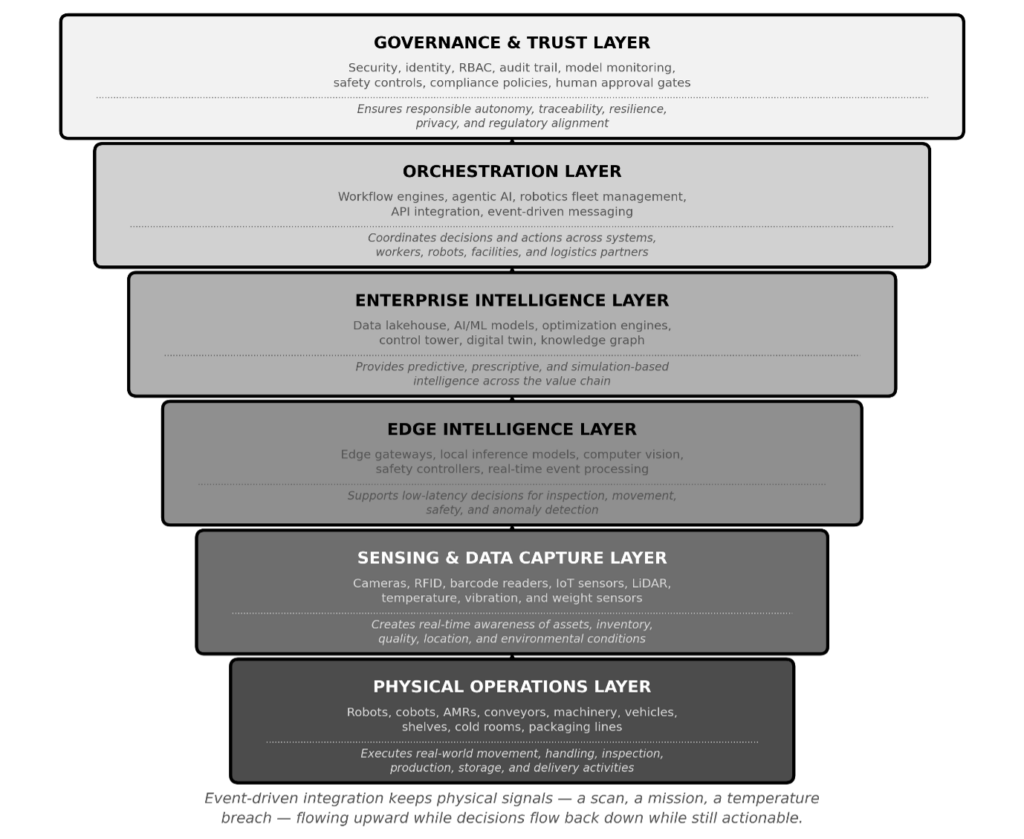
The reference architecture should be implemented with open integration principles. Physical AI solutions must communicate with existing ERP, SCM, WMS, TMS, MES, QMS, PLM, supplier portals, and customer-facing systems. Event-driven integration is particularly important because physical events occur continuously: a pallet is scanned, a robot completes a mission, a storage zone crosses a temperature threshold, a production line slows down, a shelf becomes empty, or a shipment is delayed. These signals should flow into decision engines and control towers so that the supply chain can respond while the event is still actionable.
- Core Components Involved in Physical AI Supply Chain Solutions
The first component is the sensor and perception stack. This includes cameras, thermal sensors, RFID, GPS, LiDAR, ultrasonic sensors, accelerometers, and machine telemetry. Perception models convert raw signals into operational meaning: a damaged carton, a missing label, a temperature breach, a congested aisle, an unsafe human-machine proximity, or a defective component.
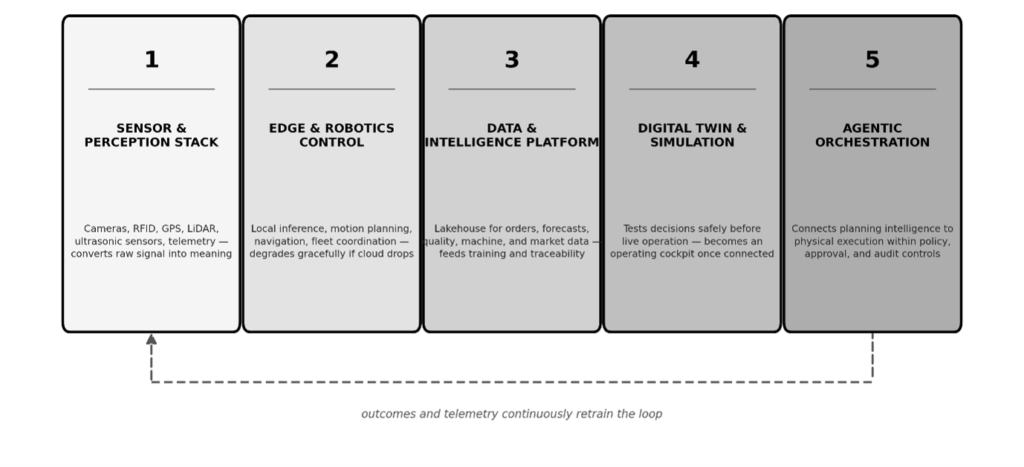
The second component is the edge and robotics control layer. It enables local inference, motion planning, robot navigation, robotic arm control, fleet coordination, and safety response. This layer should be designed for reliability and graceful degradation. If a cloud service is unavailable, the local system should still maintain safe operation and basic continuity.
The third component is the data and intelligence platform. Supply chain AI depends on high-quality data from internal and external sources: orders, forecasts, supplier commitments, transport events, warehouse inventory, quality records, machine data, weather, port congestion, market demand, and regulatory signals. A lakehouse architecture or equivalent data foundation can support streaming, batch analytics, feature engineering, model training, and historical traceability.
The fourth component is the digital twin and simulation environment. This provides a safe space to test physical decisions before applying them in live operations. A digital twin can simulate labor shifts, robot fleet size, inventory layout, production changeovers, energy consumption, lead-time variability, and service-level impact. When connected with live telemetry, the twin becomes not only a design tool but also an operating cockpit.
The fifth component is the agentic orchestration layer. It connects planning intelligence with physical execution. For example, an agent may detect that a high-priority hospital order is at risk, evaluate inventory and logistics options, recommend a fulfillment change, trigger approval, and then coordinate warehouse picking, robotic movement, label printing, and carrier scheduling. The agent should not operate as an uncontrolled black box; it must act within policies, approval thresholds, explainability requirements, and audit controls.
- Physical AI Use Cases in Healthcare and Pharmaceutical Supply Chains
Healthcare and pharmaceutical supply chains are highly suitable for Physical AI because they combine strict compliance, product sensitivity, high service criticality, and complex distribution networks. One of the most important use cases is intelligent cold-chain monitoring. Vaccines, biologics, insulin, cell therapies, and certain specialty drugs require controlled temperatures from production to patient delivery. Physical AI systems can combine IoT sensors, route context, packaging data, weather signals, and predictive models to identify likely excursions before they occur. Corrective actions may include rerouting, repositioning product, changing packaging priority, or escalating to a human supervisor.
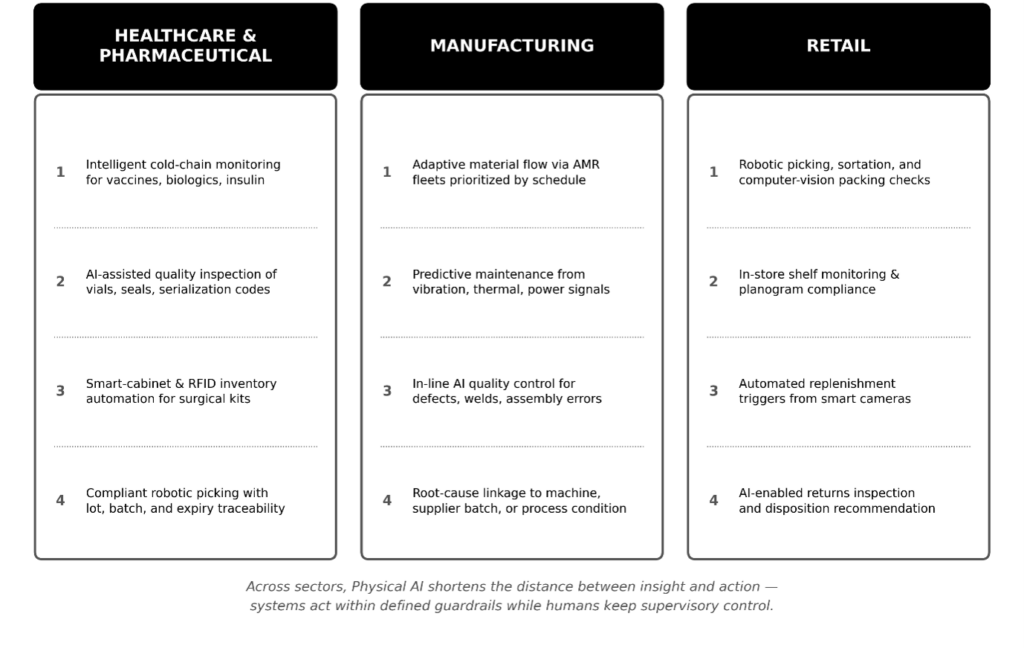
Another high-value use case is AI-assisted quality inspection in pharma manufacturing and packaging. Computer vision can inspect vials, blister packs, labels, seals, serialization codes, fill levels, and packaging integrity at higher speed and consistency than manual checks. When combined with digital batch records and manufacturing execution systems, these inspections support faster deviation detection and more reliable batch release decisions.
Hospitals and clinical networks can also use Physical AI for inventory automation. Smart cabinets, RFID-enabled storage, autonomous inventory scanning, and robotic movement can improve visibility of surgical kits, implants, high-cost drugs, and emergency supplies. This reduces stockouts, expiry risk, and manual counting effort. In pharmaceutical distribution centers, autonomous mobile robots can support compliant picking and replenishment while maintaining traceability across lot, batch, expiry date, and storage condition.
- Physical AI Use Cases in Manufacturing Supply Chains
Manufacturing supply chains benefit from Physical AI because production performance depends on the synchronization of materials, machines, people, quality, maintenance, and logistics. A leading use case is adaptive material flow. Autonomous mobile robots can move materials between receiving, storage, production lines, quality zones, and shipping docks. AI-based fleet orchestration can prioritize missions based on production schedule, due dates, machine availability, congestion, and worker safety.
Predictive maintenance is another mature and valuable use case. Physical AI systems analyze vibration, acoustic, thermal, power, and operational signals to detect early signs of equipment degradation. Instead of performing maintenance only at fixed intervals or after breakdowns, plants can schedule interventions based on risk, production impact, spare-part availability, and asset criticality. This improves uptime and reduces unplanned disruption across the supply chain.
AI-enabled quality control can detect defects during production rather than after finished-goods inspection. Vision systems can identify surface defects, dimensional deviations, assembly errors, missing components, improper welds, incorrect labels, or packaging damage. When these signals are connected to digital twins and process models, the system can identify not only that a defect has occurred but also which machine, parameter, supplier batch, or process condition may have contributed to it. - Physical AI Use Cases in Retail Supply Chains
Retail supply chains are becoming more dynamic as customers expect fast fulfillment, accurate availability, flexible returns, and consistent omnichannel experiences. Physical AI can improve retail supply chains at both the warehouse and store level. In distribution centers, robotic picking, automated sortation, computer vision-based packing validation, and autonomous yard operations can reduce cycle time and improve order accuracy. These capabilities are especially useful for high-SKU environments where product variety and demand volatility make manual operations difficult to scale.
Inside stores, Physical AI can support shelf monitoring, planogram compliance, queue detection, shrink reduction, and automated replenishment triggers. Smart cameras and sensors can identify empty shelves, misplaced products, blocked aisles, damaged merchandise, or abnormal movement patterns. Used responsibly and with privacy safeguards, these signals can help store teams improve availability and customer experience without relying entirely on periodic manual checks.
Returns management is another strong retail use case. AI-enabled inspection stations can classify returned items by condition, identify damage, verify packaging, detect fraud indicators, and recommend disposition: restock, refurbish, recycle, repair, or liquidate. This shortens the reverse logistics cycle and helps retailers recover value from returned inventory faster. - Design Principles for Successful Physical AI Adoption
Physical AI should be adopted with a business-first and safety-first mindset. The most successful programs begin with operational pain points, not technology curiosity. Leaders should identify where physical bottlenecks create measurable cost, risk, quality loss, or service failures. They should then select use cases that are feasible, repeatable, governable, and scalable across sites.
Governance must be embedded from the beginning. Physical AI systems must handle safety, accountability, explainability, access control, cybersecurity, data privacy, model drift, fallbacks, exception handling, and human override. This is especially important when autonomous systems interact with people, regulated products, production equipment, or customer-facing environments. The goal should not be uncontrolled autonomy; it should be responsible autonomy with clear operating boundaries.
A phased roadmap is usually more effective than a large, site-wide rollout. Organizations can begin with sensing and visibility, then move to AI-assisted recommendations, then controlled automation, and finally semi-autonomous execution where the risk profile is acceptable. This maturity path allows teams to learn, build trust, improve data quality, refine operating procedures, and demonstrate value before scaling. - Cost implications in Physical AI adoption
The cost implications of Physical AI adoption must be understood differently from traditional software or analytics programs. Physical AI connects intelligence with real-world execution, which means the investment extends beyond algorithms, dashboards, and cloud platforms. It includes the cost of making factories, warehouses, vehicles, cold rooms, stores, hospitals, and distribution networks ready for AI-enabled sensing, decision-making, and controlled action. Therefore, enterprises should evaluate Physical AI through a full total cost of ownership model rather than a narrow technology procurement lens.
The first cost layer is hardware and physical infrastructure. This includes cameras, RFID readers, LiDAR, temperature sensors, vibration sensors, smart shelves, industrial gateways, rugged edge devices, robots, cobots, autonomous mobile robots, machine controllers, charging stations, safety barriers, emergency-stop systems, and facility modifications. In many supply chain sites, connectivity upgrades are also required, including industrial Wi-Fi, private 5G, network segmentation, and resilient backhaul. These costs vary significantly by site layout, product type, process complexity, safety requirements, and environmental conditions.
The second layer is data, AI, and platform cost. Physical AI depends on continuous operational data streams from sensors, machines, applications, workers, and logistics networks. Enterprises must invest in data ingestion, streaming pipelines, storage, data quality, labeling, synthetic data generation, model training, edge inference, MLOps, simulation environments, digital twins, and lakehouse or equivalent data platforms. Integration costs are equally important because Physical AI must connect with ERP, SCM, WMS, TMS, MES, QMS, PLM, supplier portals, customer systems, and control towers. Without this integration, Physical AI remains an isolated automation island rather than an enterprise capability.
The third layer is engineering and integration cost. Unlike software-only deployments, Physical AI must be adapted to real operating conditions. A robotic workflow that works in one warehouse may require redesign in another because aisle width, SKU mix, lighting, packaging, floor condition, safety zones, and labor processes differ. Engineering effort is needed for robotics integration, legacy equipment connectivity, workflow orchestration, cybersecurity hardening, testing, validation, and interoperability with existing automation systems.
The fourth layer is operational and lifecycle cost. Robots require maintenance, spare parts, battery management, calibration, software updates, vendor support, and safety inspections. AI models require monitoring, retraining, drift detection, version control, and performance validation. Cyber-physical systems also require continuous patching, vulnerability management, access control, and incident response planning.
The fifth layer is organizational cost. Workforce training, role redesign, standard operating procedure updates, human-machine collaboration models, governance forums, safety certification, user adoption, and compliance documentation are essential for sustainable value realization.
ROI should therefore be measured through both direct and indirect value levers. These include throughput improvement, labor productivity, reduced downtime, lower rework and scrap, higher order accuracy, reduced stockouts, better cold-chain compliance, fewer safety incidents, lower working capital, faster cycle time, and improved asset utilization. The strongest business cases usually follow a phased investment model: start with a measurable pilot, validate operational impact, reuse reference architecture, scale across similar sites, and track value after deployment. Payback period, total cost of ownership, and risk-adjusted ROI should be reviewed continuously because Physical AI value grows when solutions are industrialized, reused, and governed across the supply chain network. - Future trends and approaches
The future of Physical AI in supply chains will be shaped by the convergence of agentic AI, multimodal foundation models, edge-native computing, digital twins, robotics, and responsible governance. The next phase will not be limited to automating isolated tasks. It will focus on creating adaptive operating systems where digital intelligence and physical execution are connected through governed, real-time feedback loops.
One major trend will be the rise of agentic Physical AI. AI agents will increasingly monitor planning signals, inventory positions, logistics constraints, production schedules, supplier commitments, service-level risks, and robotic execution status. Under human-defined policies, these agents may recommend or coordinate actions such as reprioritizing warehouse missions, adjusting replenishment, rerouting shipments, changing production sequencing, or escalating cold-chain risks. The value will come from connecting enterprise decision-making with physical execution, while keeping approval thresholds, audit trails, and human override mechanisms in place.
Foundation models and vision-language-action models will also influence the next generation of Physical AI. Multimodal models can interpret images, text, sensor data, instructions, and operational context together. This can improve quality inspection, robotic manipulation, exception handling, maintenance support, and natural-language interaction with machines. For example, an operator may ask a system why a picking robot stopped, request a visual inspection summary, or instruct a cobot to handle a new packaging variation within approved safety boundaries.
Edge-native and real-time AI will become more important as supply chains demand low-latency decisions. Cameras, robots, sensors, gateways, and industrial controllers will perform more local inference to support safety, movement, inspection, anomaly detection, and continuity even when cloud connectivity is limited. This will also help protect sensitive operational data and reduce unnecessary data movement.
Digital twins will evolve from visualization and simulation tools into operational control layers. They will support real-time scenario testing, closed-loop optimization, capacity balancing, energy management, risk prediction, and continuous improvement. For instance, a warehouse twin might not only model slotting modifications but also suggest robot fleet modifications and confirm the operational impact before to implementation.
Human-machine collaboration will become more mature. Cobots, wearable devices, augmented work instructions, voice interfaces, and AI copilots will assist operators, planners, maintenance engineers, and supervisors. The objective will not be to remove people from supply chains, but to increase their operational leverage and reduce repetitive, hazardous, or error-prone work.
Responsible autonomy will become a defining requirement. Physical AI systems must be designed with safety-by-design, explainability, cyber-physical security, privacy, model monitoring, auditability, fallback procedures, and human override. This is especially critical in healthcare, pharma, manufacturing, retail, logistics, and cold-chain networks where errors can affect patients, customers, workers, compliance, and brand trust.
Future approaches will also depend on interoperability and open ecosystems. Enterprises will increasingly use open APIs, event-driven architectures, robotics middleware, industrial data standards, Kubernetes at the edge, infrastructure as code, and modular solution design. Sustainability will become another driver, with Physical AI supporting energy optimization, waste reduction, route efficiency, circular logistics, emissions visibility, and climate-adaptive operations.
The most successful organizations will take a capability-first approach rather than a technology-first approach. Instead of building isolated pilots, they will create reusable Physical AI platforms, governance models, talent capabilities, reference architectures, and scalable solution patterns. This will allow supply chains to become more adaptive, resilient, intelligent, and physically aware over time. - Conclusion
Physical AI represents a decisive step in the evolution of supply chain technology. It moves enterprises beyond passive visibility and analytical recommendations toward adaptive, real-time, physically aware operations. When implemented well, it can improve throughput, resilience, quality, safety, compliance, working capital, service levels, and customer experience. Its real promise lies not in replacing people, but in giving people better operational leverage: machines can sense earlier, respond faster, simulate alternatives, and execute repetitive or hazardous tasks with consistency, while human experts provide judgment, governance, exception handling, and strategic direction.
For supply chain solution developers, architects, and business leaders, the implication is clear. Future-ready supply chains will not be built only with planning algorithms, dashboards, and cloud platforms. They will be built through tightly integrated digital-physical systems where AI understands the operating environment and can safely influence action. Organizations that treat Physical AI as an enterprise capability—supported by data readiness, reference architecture, phased investment, responsible governance, and domain-specific use cases—will be better positioned to build supply chains that are not merely efficient, but adaptive, resilient, and intelligent by design.