
From AI Hype to Workforce Reality: How Intelligent Automation Is Reshaping Human Capital Operations
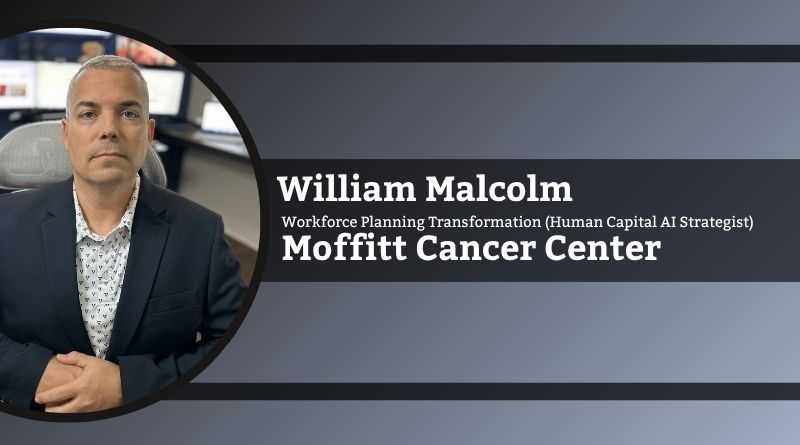
By William Malcolm, Workforce Planning Transformation (Human Capital AI Strategist), Moffitt Cancer Center
Introduction
Artificial Intelligence has moved rapidly from experimentation to expectation. Across industries, leaders are no longer asking if AI should be adopted. They are asking where it creates real value and how to implement it responsibly. Nowhere is this shift more visible than in Human Resources and Talent Acquisition, where operational inefficiencies, data fragmentation, and manual workflows have historically limited speed and scale.
The opportunity is significant. AI and automation can fundamentally redesign how organizations attract, onboard, and manage talent. But the reality is more complex. The difference between success and failure is not the technology. It is how organizations integrate AI into workflows, governance models, and decision-making processes.
The Rise of AI-Driven Workflow Automation
In many organizations, HR operations still rely on fragmented systems, manual coordination, and reactive processes. Scheduling interviews, onboarding new hires, managing documentation, and communicating with candidates often involve multiple systems and handoffs.
AI-driven workflow automation changes this dynamic. By integrating conversational AI, low-code automation platforms, and predictive analytics, organizations can:
Automate repetitive administrative tasks
Enable real-time candidate and employee communication
Surface insights from previously underutilized data
Reduce dependency on manual intervention and offshore support
In practice, onboarding timelines can be reduced from weeks to days, candidate engagement improves, and HR teams shift from administrative execution to strategic advisory roles. These outcomes are already being realized in environments that have moved beyond experimentation and into structured deployment.
Real-World Adoption: What Actually Changes
The most effective AI implementations are not standalone tools. They are workflow redesigns. For example, in onboarding and talent acquisition:
- AI-powered scheduling eliminates back-and-forth coordination
- Automated communication workflows reduce candidate drop-off
- Digital onboarding portals centralize information
- Document automation reduces compliance risk and manual effort
When workflows are redesigned end-to-end, organizations experience faster time-to-start, lower operating costs, improved experience, and more consistent processes. However, these outcomes only occur when AI is embedded into the operating model, not layered on top of existing inefficiencies.
AI and Automation are reshaping human capital operations, but the transformation is not about technology alone.
A Practitioner’s Perspective: Operating at the Edge of AI Capability
There is a growing gap between how AI is discussed and how it is actually used at an advanced level. From a practitioner standpoint, working deeply with AI across multiple layers changes your perspective. When you are actively testing autonomous agents, working with multiple AI systems, and pushing the boundaries of what these tools can do, you start to see patterns that are not yet widely understood in most organizations. At an advanced level, AI is not just a tool. It becomes an operating capability.
This includes:
- Using multiple AI systems in parallel to solve different classes of problems
- Designing workflows where AI performs execution, not just assistance
- Leveraging natural language as a control layer for business processes
- Continuously testing edge cases to understand system limitations and opportunities
This level of exposure provides a clearer view of what is possible today, which directly informs what will be possible in the near future.
The Emergence of the Agentic Manager
One of the most important shifts that will define the next phase of AI adoption is the emergence of what can be described as the agentic manager. This is not a technical role. It is an operational evolution. The agentic manager is a business leader who:
Understands business processes deeply
Uses natural language to direct and orchestrate work
Manages teams of customizable AI agents alongside human employees
Designs and adjusts workflows in real time based on outcomes
Instead of managing tasks manually, this individual manages systems of execution. In this model, work is performed through a combination of:
Human decision-making
AI-driven execution
Automated workflows that continuously learn and adapt
The manager’s role shifts from task oversight to system design and orchestration. This has significant implications for organizations:
Middle management roles will evolve, not disappear
Productivity gains will come from orchestration, not just automation
Competitive advantage will shift to those who can operationalize AI fastest and most effectively
Organizations that begin developing this capability early will have a structural advantage.
Challenges in Adoption
Despite the promise of AI, adoption is not frictionless.
1. Workflow Fragmentation
Many organizations operate across disconnected systems. Introducing AI without integration increases complexity instead of reducing it.
2. Data Governance and Risk
AI systems require access to data. Without strong governance, this creates risks related to privacy, compliance, and data exposure.
3. Change Adoption
Human behavior remains the biggest barrier. Without clear enablement and leadership alignment, adoption stalls.
Successful organizations treat AI adoption as a business transformation, not a technology rollout.
Positive and Negative Impacts of Emerging Technology
Positive Impacts
- Efficiency gains through automation
- Cost reduction through reduced manual work
- Improved decision-making through data insights
- Better experience for candidates and employees
Negative Impacts and Risks
- Over-automation that removes necessary human interaction
- Bias introduced through poorly governed models
- Data exposure from misconfigured systems
Tool proliferation without integration
AI creates value only when applied with discipline.
The Role of Governance in AI Success
AI governance is a critical success factor. Organizations that scale AI effectively establish:
- Clear prioritization of use cases
- Defined data access controls
- Ownership and accountability structures
- Continuous monitoring and audit mechanisms
In regulated environments, governance is foundational to both trust and scalability.
Looking Ahead: From Tools to Capability
The next phase of AI adoption will be defined by organizational capability. Leading organizations are focusing on:
- AI literacy across leadership
- Workforce readiness and reskilling
- Integrated human and AI operating models
- Scalable automation frameworks
The goal is not to use AI. The goal is to operate with AI.
AI and automation are reshaping human capital operations, but the transformation is not about technology alone. It is about how organizations redesign workflows, manage risk, and enable their workforce to operate differently. The next competitive advantage will not come from access to AI tools. It will come from the ability to orchestrate them. The organizations that recognize and invest in this shift, particularly through the development of agentic managers, will define the next generation of business performance.