

Inter-cloud Migration: Strategies and Roadblocks
By Dr. Anand Nayyar, Full Professor, Scientist, Vice-Chairman (Research) and Director (IoT and Intelligent Systems Lab), Duy Tan University and Dr. Magesh Kasthuri, Chief Architect and Distinguished Member of Technical Staff
Inter-cloud migration is the deliberate movement of applications, infrastructure, data, platforms, and operating practices from one public cloud provider to another. In enterprise environments, this usually means shifting selected workloads between Microsoft Azure, Amazon Web Services, and Google Cloud Platform rather than making a single, wholesale move. The motivation is rarely technical alone. Enterprises consider inter-cloud migration when cost patterns change, regulatory expectations tighten, resilience requirements evolve, contracts approach renewal, or a new business capability becomes easier to unlock on a different hyperscaler.
A mature migration strategy treats the cloud not as a destination, but as a placement decision. Some workloads may remain on AWS because they depend heavily on Amazon-native storage, analytics, or marketplace capabilities. Others may move to Azure because the enterprise has standardized on Microsoft 365, Entra ID, Windows Server, SQL Server, and Azure security services. Data-intensive analytics or AI workloads may move toward Google Cloud because of BigQuery, Vertex AI, or Google’s strengths in data engineering. The best strategy, therefore, is not “move everything,” but “place every workload where it creates the best business, technical, risk, and financial outcome.”
Why Enterprises Move from One Hyperscaler to Another
Enterprises usually decide to migrate across clouds after a structured review of business value, operational friction, and future architecture direction. Cost is often the visible trigger, especially when lift-and-shift workloads begin to show poor unit economics because they were moved without modernization. Compute overprovisioning, storage growth, licensing complexity, data egress charges, and network transfer costs can gradually convert an attractive cloud business case into a difficult financial conversation.
Capability alignment is another decisive factor. An organization deeply invested in Microsoft enterprise platforms may prefer Azure for identity, endpoint security, productivity integration, Windows workloads, and hybrid governance. A company running large-scale digital platforms may find AWS attractive because of its broad service catalogue, mature infrastructure primitives, global presence, and operational ecosystem. A data-product organization may select Google Cloud for analytics, AI, machine learning, and high-performance data warehousing. In many cases, the migration is not a rejection of the current cloud; it is a recognition that the workload has outgrown its original placement assumptions.
Regulatory pressure also shapes cloud movement. Data residency, sovereign cloud expectations, operational resilience rules, industry-specific controls, and audit expectations may require workloads to be hosted in specific regions or environments. This is especially important for financial services, healthcare, public sector, telecom, and critical infrastructure organizations. A migration from AWS to Azure, Azure to GCP, or GCP to AWS may be justified when the target provider offers a better compliance posture, region availability, encryption model, identity integration, or managed service boundary for the regulated workload.
Strategic Decision Framework for Inter-cloud Migration
A sound decision framework begins with workload segmentation. Business criticality, technical complexity, dependence depth, regulatory classification, performance sensitivity, and commercial impact should all be taken into consideration while evaluating each application, platform, database, and integration. The classic migration choices still apply: rehost, replatform, refactor, repurchase, retire, or retain. However, inter-cloud migration makes these choices more complicated because the source and target clouds may implement identity, networking, observability, storage, and managed services in very different ways.
For example, an application running on AWS EC2 with Amazon RDS and S3 cannot simply be moved to Azure Virtual Machines, Azure SQL Database, and Azure Blob Storage without examining differences in authentication, backup models, network security, replication behavior, monitoring, and service limits. Likewise, moving a data warehouse from Azure Synapse or SQL Server ecosystems to Google BigQuery may improve analytical scale but requires redesigning pipelines, access controls, query patterns, cost controls, and downstream reporting integrations. The decision must compare total value, not feature names.
The business case should include at least five dimensions: financial return, technical feasibility, security and compliance readiness, operational maturity, and business disruption risk. A workload should move only when the combined benefit exceeds the cost and risk of migration. This prevents cloud migration from becoming a provider-switching exercise driven by discounts or vendor pressure rather than long-term architecture value.
Inter-cloud migration is not a simple relocation of servers from one hyperscaler to another. It is a business-led, architecture-driven transformation that demands careful judgment across cost, risk, resilience, compliance, and innovation.
Key Interlocks Required for Execution
Inter-cloud migration succeeds only when several enterprise interlocks work together. The first is architecture governance. Enterprise architecture, solution architecture, security architecture, and platform engineering teams must agree on landing zone design, identity model, network topology, environment strategy, observability standards, policy controls, and deployment patterns before migration waves begin. Without this foundation, each application team invents its own target state, creating inconsistency and operational debt.
The second interlock is finance and commercial governance. The CFO organization, procurement, FinOps teams, and vendor management functions must evaluate price-performance, reserved capacity commitments, enterprise agreements, licensing portability, marketplace contracts, support tiers, and exit costs. A cloud migration that looks attractive at the infrastructure level may become financially weak after data transfer costs, dual-run periods, retraining, tooling changes, or contract penalties are included.
The third interlock is security, risk, and compliance. The CSO or CISO function must validate the target cloud’s controls for identity federation, privileged access, key management, encryption, logging, threat detection, vulnerability management, data residency, audit retention, and incident response. In practice, a migration can be technically ready but blocked because security evidence, regulatory approvals, or operational control mappings are incomplete.
The fourth interlock is business continuity. Application owners, operations teams, service management, and business stakeholders must agree on acceptable downtime, cutover windows, rollback procedures, communication plans, support readiness, and service-level objectives. Inter-cloud migration often creates a dual-state period in which data, users, monitoring, and operational responsibilities are split across clouds. That transition must be managed with discipline.
Roles Involved in an Inter-cloud Migration Strategy
The CTO typically owns the technology vision and target architecture. This role decides whether the migration should preserve the current architecture, gradually modernize it, or use the move as an opportunity to re-architect applications. The CTO also arbitrates cloud-native versus cloud-agnostic choices, defines engineering standards, and ensures that platform decisions do not lock the enterprise into another unsuitable state.
The CIO connects migration to enterprise operating priorities. This includes portfolio rationalization, IT service continuity, user experience, application ownership, vendor coordination, and change management. The CIO ensures that migration waves are aligned with business calendars, upgrade cycles, transformation programs, and enterprise risk appetite.
The CFO provides financial discipline. Inter-cloud migration must be evaluated using total cost of ownership, not only headline cloud pricing. The CFO’s team examines run-rate savings, migration investment, stranded commitments, license implications, training cost, dual operations, depreciation, tax treatment, and long-term consumption risk. FinOps teams translate these concerns into tagging standards, budget alerts, unit-cost dashboards, and cloud consumption accountability.
The CSO or CISO protects the enterprise from avoidable exposure during and after migration. This responsibility includes threat modeling, control validation, identity and access governance, key management, security monitoring, incident response integration, compliance testing, and approval of production readiness. The function is especially crucial when workloads depend on managed services with disparate shared responsibility borders or when data is transferred between jurisdictions.
Other roles are equally important. Enterprise architects define reference patterns. Cloud platform engineers build the landing zone. Application owners classify and remediate workloads. Data architects plan replication and validation. Network teams design connectivity, routing, DNS, and firewall rules. SRE and operations teams prepare monitoring, reliability engineering, runbooks, and incident processes. Procurement manages vendor agreements. Legal and compliance teams review residency, contractual, and regulatory exposure.
Provider Context: Azure, AWS, and Google Cloud
A migration to Azure is often compelling for enterprises with strong Microsoft estates. Workloads built around Windows Server, Active Directory, SQL Server, .NET, Microsoft 365, Power Platform, and enterprise security programs can benefit from Azure’s identity integration, hybrid capabilities, and governance services. However, moving from AWS or GCP to Azure requires careful translation of account structures, IAM policies, virtual networks, managed database features, object storage behavior, and monitoring practices into Azure subscriptions, management groups, resource groups, Azure Policy, Entra ID, and Azure-native operations.
A migration to AWS may be attractive when the enterprise needs broad infrastructure flexibility, mature primitives, partner ecosystem depth, global reach, and extensive managed services. Moving from Azure or GCP to AWS means redesigning governance around AWS Organizations, accounts, IAM, VPCs, security groups, CloudTrail, CloudWatch, S3, EBS, RDS, EKS, Lambda, and related services. The challenge is not only replacing services, but ensuring that operational models, cost controls, encryption practices, and resilience designs are adapted to the AWS way of working.
A migration to Google Cloud is frequently considered for data analytics, AI, machine learning, Kubernetes-centric platforms, and modern data product architectures. BigQuery, Vertex AI, GKE, Cloud Run, and Google’s data services can be strong motivators. Moving from AWS or Azure to GCP requires mapping existing identity, network, data, compute, and platform constructs into projects, folders, VPCs, IAM roles, service accounts, Cloud Logging, Cloud Monitoring, Cloud Storage, and managed database services. The largest design effort usually appears around data pipelines, access controls, and cost predictability for analytical workloads.
Application Migration Strategy
Application migration should begin with discovery and dependency mapping. Teams must identify runtime stacks, frameworks, middleware, external integrations, authentication flows, batch jobs, APIs, data stores, downstream consumers, and operational dependencies. This assessment determines whether an application should be rehosted quickly, replatformed onto managed services, refactored for cloud-native scalability, replaced with SaaS, retained temporarily, or retired.
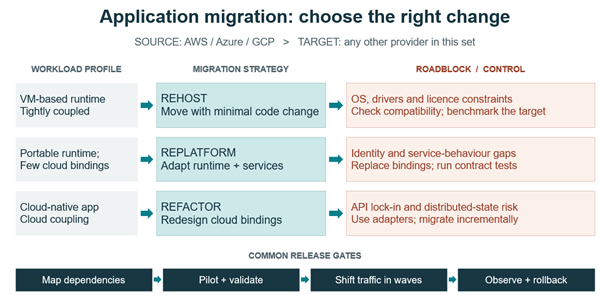
For application workloads, inter-cloud migration is safest when executed in waves. Low-risk applications should move first to validate landing zones, CI/CD pipelines, identity federation, monitoring, backup, and support processes. Business-critical systems should move only after patterns are proven and rollback plans are rehearsed. Where possible, blue-green deployment, canary release, traffic shifting, and API gateway abstraction can reduce downtime. Applications that depend heavily on native services such as AWS Lambda, Azure Functions, or Google Cloud Functions may require code-level redesign because event models, permissions, observability, and deployment packaging vary across providers.
Containerized applications can offer more portability, but portability is not automatic. Kubernetes workloads moving among Amazon EKS, Azure Kubernetes Service, and Google Kubernetes Engine still require changes in ingress, storage classes, identity integration, secrets management, service mesh, observability, and cluster security. A practical strategy separates application code from infrastructure assumptions and moves environment-specific configuration into controlled deployment templates.
Infrastructure Migration Strategy
Infrastructure migration should be led by a well-designed target landing zone. This includes accounts or subscriptions, network segmentation, private connectivity, DNS, firewalls, identity integration, logging, security baselines, policy enforcement, backup, disaster recovery, and operational monitoring. The target cloud must be ready before workloads arrive. Otherwise, teams end up rebuilding foundational services in the middle of migration, which increases risk and delays cutover.
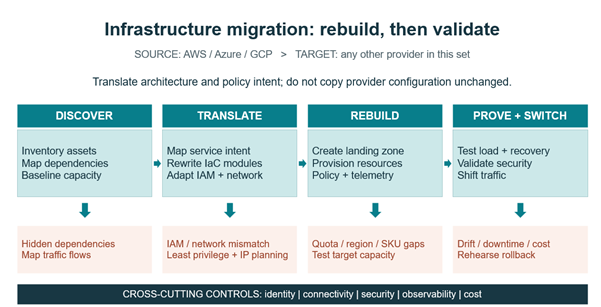
Infrastructure-as-Code is an essential enabler. Terraform, Bicep, AWS CloudFormation, Cloud Development Kit, Pulumi, and similar tools can help codify target environments, reduce configuration drift, and make migration repeatable. However, templates cannot be copied blindly from one cloud to another. AWS IAM policies do not directly become Azure RBAC assignments, and Azure virtual network designs do not map perfectly to Google Cloud VPC models. The strategy must translate intent, not syntax.
Network migration is often the hidden critical path. Private links, VPNs, ExpressRoute, Direct Connect, Cloud Interconnect, DNS forwarding, firewall inspection, IP address planning, routing domains, and latency requirements must be designed together. Enterprises should also account for a coexistence phase in which users, data, monitoring, and integrations operate across both the source and target clouds. This phase needs clear routing, observability, and incident ownership.
Data Migration Strategy
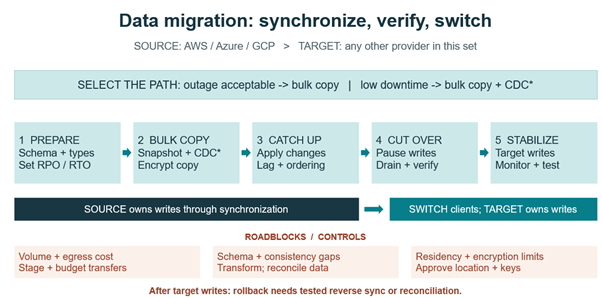
Data migration needs the highest level of caution because data has gravity, regulatory sensitivity, and operational dependency. The first step is classification: identify structured, semi-structured, and unstructured data; determine sensitivity; document ownership; map retention rules; and capture residency constraints. The next step is movement planning. Small datasets may move over secure network channels, while large datasets may require bulk transfer appliances, staged replication, database migration services, or parallel synchronization.
From AWS to Azure, teams may map S3 to Azure Blob Storage, Amazon RDS to Azure SQL Database or Azure Database services, Redshift to Synapse or Fabric-aligned architectures, and AWS Glue pipelines to Azure Data Factory or Synapse pipelines. From Azure to GCP, teams may map Blob Storage or Data Lake Storage to Cloud Storage, Synapse or SQL-based analytics to BigQuery, and Azure ML workflows to Vertex AI where appropriate. From GCP to AWS, BigQuery migration requires special care because SQL dialects, partitioning strategies, cost models, and access controls differ significantly from Amazon Redshift, Athena, or lakehouse patterns built on S3.
A robust data migration plan should include reconciliation rules, checksum validation, row counts, sample comparisons, lineage verification, access testing, performance benchmarking, and business sign-off. Cutover should be designed around transaction consistency. For mission-critical databases, enterprises may use continuous replication followed by a short freeze window. For analytical platforms, parallel run periods are useful because business users can compare reports and dashboards before the old platform is retired.
Common Roadblocks in Inter-cloud Migration
The most common roadblock is hidden dependencies. Legacy applications often depend on hard-coded IP addresses, undocumented batch jobs, shared file paths, security groups, service accounts, certificates, DNS entries, or integration queues that are discovered only during testing. Another obstacle is cloud-native lock-in. Managed databases, serverless runtimes, event buses, data warehouses, proprietary monitoring tools, and identity models may have no exact equivalent in the target cloud.
Cost surprises are equally disruptive. During migration, enterprises may pay for source and target environments at the same time. They may also incur data egress charges, additional observability costs, expanded backup storage, migration tooling fees, and short-term consulting expenses. If FinOps controls are introduced late, the target cloud can inherit the same inefficiencies that caused dissatisfaction with the source cloud.
Security and compliance gaps frequently delay production cutover. Missing logs, incomplete IAM reviews, weak key management, inadequate segregation of duties, poor vulnerability visibility, or unclear incident response procedures can force rework. People readiness is another understated challenge. Cloud engineers who are confident on AWS may need time to become productive on Azure or GCP. Similarly, operations teams must learn new dashboards, service limits, support processes, and failure modes.
Recommended Execution Roadmap
Inter-cloud migration should be executed as a governed programme rather than a sequence of independent workload moves. The first phase is discovery and assessment. Teams should inventory applications, infrastructure, data, interfaces, licenses, security controls, and operational dependencies. Each workload should be assigned a migration treatment—retain, retire, rehost, replatform, refactor, repurchase, or relocate—and prioritized according to business criticality, migration complexity, regulatory obligations, and expected value.
The second phase is target-state design and mobilization. Before workloads move, the enterprise should establish a secure landing zone covering account or subscription structures, identity federation, least-privilege access, network connectivity, encryption, logging, policy enforcement, backup, disaster recovery, and FinOps controls. Rather than being presumed to be functionally identical, service mappings between AWS, Azure, and Google Cloud should be verified through design decision documents.
Execution should begin with a proof-of-migration wave containing low-risk but representative workloads. This validates deployment pipelines, Infrastructure-as-Code modules, data-transfer methods, monitoring, service management, and rollback procedures. Subsequent migration waves should group applications by dependency and business process, with explicit entry and exit criteria. Data reconciliation, performance testing, security validation, resilience testing, and business acceptance must precede every production cutover.
After cutover, teams should enter an optimization and decommissioning phase. This includes rightsizing, commitment planning, performance tuning, control validation, knowledge transfer, and formal retirement of source resources. Migration success should be measured through availability, performance, security findings, unit cost, migration velocity, user impact, and realized business benefits—not merely the number of servers transferred.
Cost implication in Inter-cloud migration
The financial impact extends well beyond target-cloud compute and storage prices. The business case must include migration engineering, application remediation, data conversion, testing, tooling, consulting, workforce training, and programme governance. Enterprises should also budget for temporary connectivity and the dual-run period, during which source and target environments operate simultaneously.
Cloud-provider data egress can be a significant cost, particularly for large data estates or extended replication periods. Other frequently overlooked costs include database and operating-system license changes, stranded reservations or savings commitments, contract-termination charges, expanded backup capacity, cross-cloud observability, security tooling, and post-migration support.
Cost modelling should therefore compare a multi-year total cost of ownership under realistic consumption scenarios. FinOps controls—tagging, budgets, anomaly detection, unit-cost metrics, showback or chargeback, and commitment management—should be implemented before migration waves begin. The enterprise should track both migration expenditure and benefit realization, including avoided renewal costs, productivity improvements, resilience gains, and modernization value. Decommissioning must be governed carefully because delayed shutdown of source resources can eliminate anticipated savings and turn a technically successful migration into a financially unsuccessful one.
Conclusion
Inter-cloud migration is not a simple relocation of servers from one hyperscaler to another. It is a business-led, architecture-driven transformation that demands careful judgment across cost, risk, resilience, compliance, and innovation. Azure, AWS, and Google Cloud each offer strong capabilities, but they express those capabilities through different operating models. The enterprises that succeed are those that avoid emotional or vendor-driven decisions, classify workloads honestly, design strong governance interlocks, and migrate in measured waves with clear accountability. Done well, inter-cloud migration gives the enterprise more choice, better alignment, and a stronger foundation for future digital growth. Done poorly, it merely moves complexity from one cloud bill to another.