
The Entrepreneurial Mindset in an AI World
How Entrepreneurship Education is Preparing Our Next Generation of Workers
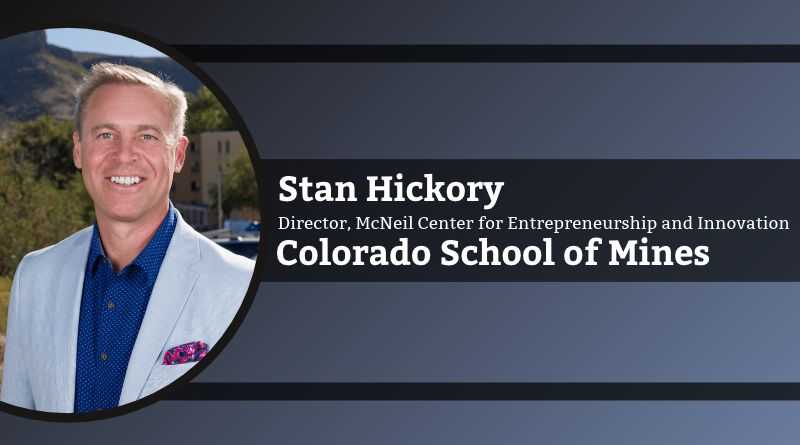
By Stan Hickory, Director of the McNeil Center for Entrepreneurship and Innovation and Colorado School of Mines
Artificial Intelligence is changing what it means to be prepared for the world of work. Students can use AI to summarize research, analyze data, generate code and produce a first draft in minutes. The important question for educators is: How do we prepare our students for this new world of work? The answer is to help them develop an entrepreneurial mindset.
This philosophy is central to the work we are doing through the McNeil Center for Entrepreneurship and Innovation at Colorado School of Mines. We encourage students to be curious, make connections and create value. For us, that means helping technically talented students look beyond whether something can be built and ask whether it should be built, whose problem it solves and how it will improve people’s lives. Through venture development, industry challenges, mentorship and other hands-on experiences, students work with real people on problems that do not have predetermined answers. AI can help them analyze information, explore possibilities and develop solutions more quickly, but students must still recognize the opportunity, understand the people affected, bring together the right expertise and turn an idea into meaningful value. That combination of technical ability and entrepreneurial thinking is what we are working to develop at the McNeil Center.
I asked leaders from business and education whether students who develop an entrepreneurial mindset will be better prepared for an AI-driven world. Their answers point to a clear conclusion. Entrepreneurial education extends beyond starting companies. It develops judgment, agency, adaptability and the ability to identify opportunities.
An entrepreneurial education helps students decide what information means, when to question it and how to use it responsibly.
Mike Raab
Brad Feld, a partner at Foundry, co-founder of Techstars and influential early-stage investor, sees AI as part of a larger transformation. He contends that firms have been improving management systems designed for a previous industrial era for almost 80 years and have spent the last 50 years automating them. AI will do more than accelerate those systems. “It is now going to be completely upended finally by completely new processes,” he said. Students entering the workforce today will build their careers inside that transition.
If established processes are being rewritten, following directions will not be enough. Seth Levine, a partner at Foundry, bestselling author and longtime venture capitalist, believes the essential human capability is judgment. AI has an edge when a problem has a right solution since it can examine more data than a human. But product choices, investments, personnel decisions and ethical tradeoffs require people to decide what matters with incomplete information.
“The entrepreneurial mindset is really judgment training in disguise,” Levine said. “You put students in front of an ambiguous problem, make them commit to a decision with incomplete information, and then make them live with the result. That’s the only way the muscle gets built.”
Levine does provide a few words of caution that AI can weaken rather than strengthen judgment when people use it as a substitute for thinking. “I also think it’s the area of greatest risk, especially to younger people who have had less time to hone their judgment faculties,” he said. “It’s easy to lean on AI, and I see many people making the mistake of outsourcing judgment and decision-making to AI when, in fact, they should be using AI to accelerate their own learning and perspective to enhance their judgment.”
Humans being a part of the decision-making process is key. Students who develop these skills will be well positioned. Judgment develops through consequences. A model can recommend reorganizing a team, but it does not have to work beside the people affected. It can deny a customer’s request without preserving that relationship. Human decision-makers have something at stake.
Entrepreneurial learning also teaches students to define problems. “When the cost of generating solutions drops to near zero, picking the right problem becomes most of the job,” Levine said.
Ed Hidalgo is a nationally recognized career education and workforce-development leader and a master trainer and consultant with Educators Cooperative. He uses the RIASEC career-interest framework to help students understand their academic and career interests and connect them to possible career pathways. “We are hunting for interests when we use RIASEC. Inside of those interests, we work to identify and develop strengths.”
For Hidalgo, the advantage created by an entrepreneurial mindset is agency. AI can help research a market, create a pitch, analyze financials and build a prototype. The differentiator is what someone does with that assistance. “Someone still has to say, ‘I see an opportunity here and I’m going to do something about it,’” he said. “AI gives individuals extraordinary leverage; Enterprising capabilities help them turn that leverage into action and value.”
Those capabilities include recognizing opportunities, taking initiative, building trust, accepting intelligent risks and turning ideas into something another person values. Not every student needs to become an entrepreneur, Hidalgo notes, but every student can develop entrepreneurial capabilities and learn to build teams with complementary strengths.
Professor Gurpreet Singh Jagpal OBE, chief commercial officer at Aston University and a leader recognized for his service to enterprise and entrepreneurship education, reaches a similar conclusion. “Judgement will become more valuable, not less,” he said. “AI can generate options; humans still need to decide which options matter.”
Jagpal believes universities must shift from knowledge reproduction to application, synthesis, judgment, and creation. Students need real problems from real organizations, contact with customers and assignments without predetermined answers. They must test assumptions, defend decisions, learn from failure and try again.
Laura Burke has seen this approach work before college. Burke is the founding principal of Clara Brown Entrepreneurial Academy, Colorado’s first public K–8 school built around entrepreneurial learning, and author of The Pursuit of What’s Possible. She has watched elementary students create products, set prices, pitch ideas and sell to real customers. Through industrial initiatives, mentorships, and internships, older students gain knowledge.
Burke points specifically to VALE and the opportunities it creates for older students. Through internships and other real-world experiences, students begin building professional networks and receiving substantive feedback from industry professionals before they graduate. That entrepreneurial education gives them an advantage over a typical high school experience: they are learning how to operate in professional settings, test their thinking with practitioners and connect classroom work to real opportunities.
“You can teach a student about risk-taking, but at some point, they need to put an idea in front of other people and risk having it rejected,” Burke said. “You can talk about resilience, but it becomes meaningful when something they care about doesn’t work and they have to decide what to do next.”
Burke argues that useful learning experiences combine uncertainty with a real audience. Students need freedom to choose what happens next and support to reflect, seek feedback and adjust. Public demonstrations, peer reviews, and portfolios can all show progress that a test score cannot.
Mike Raab, executive director of The Garage at Northwestern University and co-author of Founded, frames the stakes in career terms. “The only certainty in the AI future is there will be immense change,” he said. “Those who wait around for clear instructions of what they should do next in their career will be left behind.” Students who identify opportunities, adapt and act will be better equipped for that change.
Technical knowledge still matters, as does AI literacy. But the shelf life of specific knowledge is shrinking. An entrepreneurial education helps students decide what information means, when to question it and how to use it responsibly.
Entrepreneurial education offers a practical way to do that. It gives students repeated experience with ambiguity, imperfect information, real people and meaningful consequences. In a world where AI can produce more answers than any person can absorb, the advantage may belong to those who can ask better questions, choose what matters and make something happen.