

Tokenomics and FinOps Strategies for AI services
By Dr. Anand Nayyar, Full Professor, Scientist, Vice-Chairman (Research) and Director (IoT and Intelligent Systems Lab), Duy Tan University and Dr. Magesh Kasthuri, Chief Architect and Distinguished Member of Technical Staff
Introduction
As organisations increasingly adopt AI services on cloud platforms, managing costs becomes critical for ensuring sustainable operations and profitability. AI workloads, particularly those leveraging natural language processing and generative models, often incur variable costs based on consumption. Effective cloud cost management not only safeguards budgets but also maximises value from AI investments. This article explores the interplay between Tokenomics, token optimisation, and FinOps strategies for AI services in AWS, Azure, and GCP.
Understanding Tokenomics in AI Services
Tokenomics refers to the economic principles governing token consumption in AI services. In the context of cloud platforms, tokens typically represent units of computational or data processing capacity, such as API calls or processed characters. Each cloud provider structures token usage differently, influencing cost models and optimisation opportunities. Understanding tokenomics is essential for predicting expenses and aligning AI consumption with business goals.
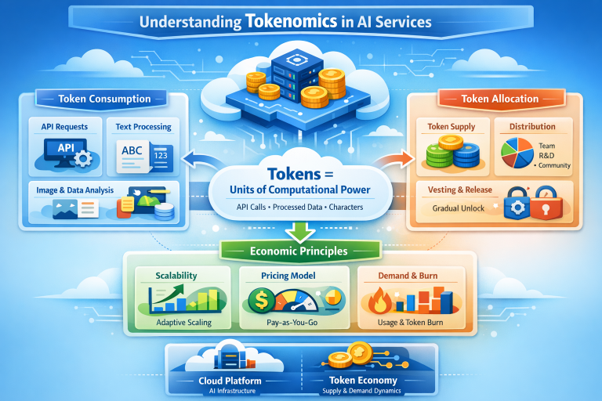
For example, OpenAI’s API charges based on tokens processed per request, while Google Cloud’s Vertex AI and Azure’s AI offerings have their own metrics and pricing tiers. Tokenomics helps teams forecast costs, set usage limits, and determine the most efficient service configurations for their workloads.
Token Optimisation Strategies in AWS, Azure, and GCP
Optimising token consumption is a cornerstone of cost management for AI services. Each cloud platform offers unique tools and settings to help users fine-tune their AI workloads:
- AWS: AWS enables optimisation through features like batch processing, model selection, and inference scaling. Using services such as Amazon SageMaker, teams can choose lighter models or adjust batch sizes to reduce token usage, thereby lowering costs.
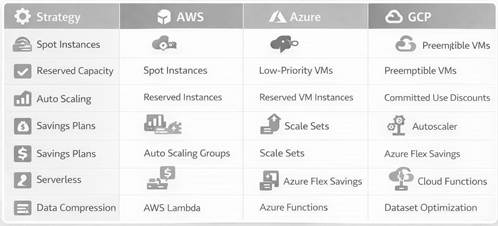
- Azure: Azure’s AI platform provides detailed analytics on token consumption. By leveraging Azure Cost Management and monitoring tools, organisations can identify high-cost workloads and reconfigure them for efficiency, such as switching to lower-precision models or reducing request frequency.
- GCP: Google Cloud offers granular token tracking via Vertex AI and Cloud Monitoring. Teams can set quotas, optimise API calls, and select cost-effective model endpoints to minimise token expenditure.
Across all platforms, strategic token optimisation involves regularly reviewing usage patterns, tuning models, and implementing automated scaling policies to prevent unnecessary consumption.
Cloud cost management for AI services hinges on understanding tokenomics, optimising token usage, and implementing robust FinOps practices.
Proactive FinOps Measures for AI Services
FinOps, or Financial Operations, is a collaborative approach to managing cloud costs, especially relevant for AI workloads. Proactive measures help organisations control spending and ensure transparency:
- Budgeting: Setting clear budgets for AI services and monitoring adherence using built-in cloud tools or third-party solutions.
- Internal Chargeback: Allocating AI consumption costs to departments or projects based on usage, fostering accountability and informed decision-making.
- Optimised AI Service Usage: Encouraging teams to use AI services judiciously, such as batching requests or choosing cost-efficient models.
- Cost Usage Alerts: Implementing automated alerts when spending approaches predefined thresholds, enabling timely intervention.
- Transparent Cost Governance: Ensuring visibility of AI service costs across teams, supported by dashboards and regular reporting.
Real-Time Examples: FinOps Implementation with AI Services
Several organisations have successfully implemented FinOps strategies for AI services on cloud platforms:
- AWS Case: A fintech company used Amazon SageMaker to deploy AI models for fraud detection. By monitoring token usage and setting cost alerts, they identified excessive consumption during peak hours and optimised batch sizes. Internal chargeback mechanisms helped allocate costs to relevant business units, resulting in a 20% reduction in monthly AI spend.
- Azure Scenario: An Indian healthcare provider leveraged Azure’s AI analytics to track token consumption across departments. With proactive budgeting and transparent governance, they avoided budget overruns and fostered responsible AI usage. They were able to quickly handle unforeseen rises thanks to cost warnings.
- GCP Example: A retail firm used Vertex AI and Cloud Monitoring to analyse token usage in customer service chatbots. By optimising API calls and selecting efficient model endpoints, they reduced token costs and improved performance. Internal chargeback ensured each team bore its fair share of AI expenses.
Key Takeaways for Effective Cloud Cost Management with AI
Effective cloud cost management for AI services requires organizations to treat AI consumption as a dynamic, usage-driven financial model rather than a fixed infrastructure expense. Unlike traditional workloads, AI services introduce cost variability through tokens, API calls, model inference time, vector database queries, GPU/TPU utilization, storage, and data movement. Therefore, the first key takeaway is the need for end-to-end cost visibility across the AI lifecycle—from data ingestion and model training to inference, monitoring, and continuous optimization.
A second critical takeaway is that tokenomics must be embedded into architecture decisions. Teams should evaluate model selection, prompt length, context window usage, response size, embeddings generation, and frequency of API calls before deploying AI services at scale. Smaller or specialized models may deliver better cost-performance ratios than large general-purpose models for domain-specific workloads. Recurring inference costs can also be greatly decreased by rapid compression, caching, batching, retrieval-augmented generation optimization, and response limitation.
Third, organizations must adopt a FinOps operating model for AI. This includes budget allocation, project-level tagging, cost anomaly detection, chargeback or showback models, and automated alerts. AI cost governance should involve engineering, finance, data science, security, and business teams to ensure financial accountability without restricting innovation.
Another important consideration is continuous monitoring and optimization. AI workloads evolve rapidly, and cost assumptions made during proof-of-concept stages may not hold in production. Real-time dashboards, model performance metrics, token consumption reports, and utilization analytics should be reviewed regularly.
Finally, successful AI cost management depends on balancing cost, performance, accuracy, latency, and compliance. The cheapest model or infrastructure option may not always be optimal. Sustainable AI operations require technical teams to evaluate business value per token, per inference, and per workload, ensuring that AI investments remain measurable, scalable, and financially controlled.
Third party tools for Cloud Cost Management
While AWS, Azure, and GCP provide native cost management capabilities, many organizations rely on third-party FinOps platforms to gain deeper visibility, automation, and multi-cloud governance. These tools are especially valuable for AI workloads because enterprises often consume services across multiple providers, including cloud-native AI platforms, GPU clusters, managed Kubernetes, vector databases, and external large language model APIs.
Tools such as Apptio Cloudability, VMware CloudHealth, Flexera One, CloudZero, Harness Cloud Cost Management, Vantage, and Datadog Cloud Cost Management provide advanced cost allocation, anomaly detection, forecasting, budget tracking, and unit economics. They help organizations map cloud spend to business units, applications, environments, and AI projects using tags, labels, accounts, and metadata. This allows teams to determine the cost per model, cost each inference, cost per customer encounter, or cost per business workflow for AI services.
For containerized and GPU-intensive AI workloads, platforms such as Kubecost, OpenCost, CAST AI, Densify, and Spot by NetApp support Kubernetes cost monitoring, rightsizing, workload scheduling, and infrastructure optimization. These tools are useful where AI training or inference runs on Amazon EKS, Azure AKS, Google Kubernetes Engine, or self-managed GPU clusters. They help identify underutilized nodes, oversized instances, inefficient autoscaling policies, and idle accelerators.
In addition, AI observability and LLMOps tools such as LangSmith, Langfuse, Helicone, Arize AI, Weights & Biases, and Humanloop are increasingly relevant for token-level cost tracking. They provide visibility into prompt usage, model latency, completion size, error rates, and user-level consumption patterns.
When integrated with FinOps processes, these third-party tools enable proactive governance, automated optimization, accurate chargeback, and real-time cost accountability. By offering a uniform financial control layer spanning infrastructure, models, APIs, and business outcomes, they supplement native cloud technologies for businesses using AI at scale.
Conclusion
Cloud cost management for AI services hinges on understanding tokenomics, optimising token usage, and implementing robust FinOps practices. By proactively budgeting, establishing chargeback systems, and leveraging platform-specific tools, organisations can control AI costs and derive maximum value from their cloud investments. Transparent governance and real-time monitoring further enhance accountability and efficiency, setting the foundation for sustainable AI operations in the cloud.