
From Insight to Action: Why AI Must Drive Decisions, Not Just Insights
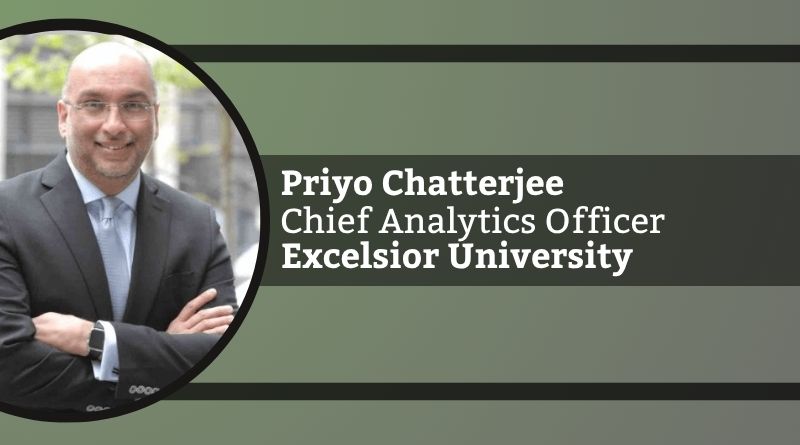
By Priyo Chatterjee, Chief Analytics Officer, Excelsior University
The Problem with AI Today
Artificial intelligence is everywhere. Every industry is investing in it, experimenting with it, and trying to operationalize it. Higher education is no exception. Institutions are building data platforms, deploying predictive models, and generating increasingly sophisticated insights. Yet, despite this momentum, the results have been inconsistent.
The reason is straightforward. Most organizations have become very good at producing insights, but far less effective at acting on them. Dashboards are richer. Models are more accurate. Forecasts are more precise. But when it comes to changing outcomes in a meaningful way, many institutions still fall short.
Insight does not create impact. Decisions do.
This is the fundamental gap in how AI is being applied today. The challenge is no longer access to data or even analytical capability. The challenge is translating insight into consistent, scalable action.
A Different Approach
At Excelsior University, we took a different path. Instead of building isolated models or standalone analytics tools, we focused on creating a unified, AI-powered decisioning platform, the Student Intervention Recommender, or StIR.
The premise is simple but consequential. AI should not sit on the sidelines as a reporting or advisory function. It should be embedded directly into the workflows where decisions are made. It should guide action in real time, not simply inform it after the fact.
StIR was designed with this philosophy at its core. It integrates data across the student lifecycle and delivers clear, actionable recommendations to the people responsible for outcomes.
The goal is not more information. The goal is better decisions.
From Prediction to Decision
For years, analytics has evolved along a predictable path, from descriptive to predictive. We have become adept at answering what happened and what is likely to happen next. But there is a critical step missing in that progression: what should we do about it?
Prediction without action has limited value.
StIR is designed to close that gap. It operates as a decision intelligence layer that sits at the center of the student lifecycle. It continuously ingests data from marketing, enrollment, and academic systems, applies predictive and prescriptive models, and translates those outputs into prioritized, role-specific actions.
As illustrated in Figure 1, this creates a closed-loop system. Data informs decisions. Decisions drive actions. Actions generate new data. And the system continuously learns and improves over time.
This is a fundamentally different operating model. Instead of static insights and periodic analysis, it enables dynamic, real-time decision-making at scale.

AI at Scale: Extending Beyond a Single Institution
While platforms like StIR are designed to drive decisions within an institution, the true potential of AI emerges when those capabilities extend across a broader ecosystem.
At Excelsior, this is increasingly important as we build what we refer to as a Constellation of institutions, a connected network that enables students to move more seamlessly across universities, stack credentials, and access coordinated support throughout their educational journey.
In this context, AI is no longer just optimizing decisions within a single lifecycle. It is enabling continuity of decisions across multiple institutions.
Platforms like StIR become even more critical in this environment, enabling shared understanding of student needs and actions across institutional boundaries.
AI becomes the connective tissue that enables a more integrated, flexible, and student-centric higher education ecosystem.
Where Impact Happens
The value of this approach becomes most evident when applied to real institutional challenges, and increasingly, across a broader ecosystem of institutions.
In enrollment, StIR identifies high-intent prospects and recommends targeted engagement strategies, enabling teams to focus effort where it matters most, whether within a single institution or across partner pathways within the Constellation.
In retention, StIR surfaces at-risk students early and drives timely intervention, reducing melt and improving continuity. We have experienced our lowest melt rates on record for six terms in a row after implementing the Melt Module, which is an early sign of impact. As this capability extends across institutions, it creates the opportunity to support students more consistently, even as they move between programs and partners.
Within Academics, StIR enables proactive support, helping improve student outcomes and progression, not just within courses, but across a more flexible, multi-institution learning journey.
In the end, the ability to reliably convert insight into action at the institutional and ecosystem levels, rather than the forecast itself, is what makes a difference.
What It Really Takes
Operationalizing AI requires integrated data, adoption, and embedded workflows. It must be trusted and used consistently.
Organizations must act on directional evidence, balancing rigor with speed.
The Risk and the Opportunity
AI enables better decisions but introduces risks. The goal is augmentation, not replacement of human judgment.
What Comes Next
The future belongs to organizations that make better decisions, consistently and at scale.
That is the real promise of AI, intelligence that drives action, impact, and outcomes.
Author Biography:
Priyo Chatterjee, PhD, is the chief analytics officer at Excelsior University, where he leads the institution’s data and analytics strategy to improve the student journey across marketing, enrollment, advising, and academic affairs. He is the architect of Excelsior’s flagship Student Intervention Recommender (StIR), an AI-powered decision-intelligence platform, that identifies at-risk students, diagnoses underlying challenges, and recommends targeted interventions. Under his leadership, Excelsior has advanced the use of machine learning and artificial intelligence to optimize enrollment, persistence, and student success.
Dr. Chatterjee is the author of “Analytics in the Age of AI” and has written extensively on the role of artificial intelligence in transforming higher education and business strategy. Prior to joining Excelsior, he held senior leadership roles at Meta, Southern New Hampshire University, and American Express, and founded AiLytica, an advanced analytics consulting firm. He holds a PhD in Economics from Purdue University and is a frequent contributor to thought leadership on analytics, decision intelligence, and student success.