
The Future of the CXO Role with Ambient and Assisted AI Agents
By Dr. Anand Nayyar, Full Professor, Scientist, Vice-Chairman (Research) and Director (IoT and Intelligent Systems Lab), Duy Tan University and Dr. Magesh Kasthuri, Chief Architect and Distinguished Member of Technical Staff
Introduction
In March 2026, there was a Wall Street Journal article on Mark Zuckerberg’s AI Agent for CEOs, informally referred to as “Multi Mark,” which represents a significant stride forward in the integration of artificial intelligence within executive leadership roles. Designed to assist and augment the decision-making capabilities of chief executives, Multi Mark leverages advanced algorithms and real-time data analysis to offer strategic guidance, streamline operations, and facilitate more informed choices. By simulating the cognitive and analytical prowess of a seasoned CEO, this agent acts as a digital twin, capable of handling complex tasks and responding to dynamic business environments.
Looking ahead, the emergence of Multi Mark could set a precedent for the creation of specialized CXO Agents tailored to various leadership positions, such as CFOs, COOs, and CIOs. As organizations increasingly seek efficiency and innovation, these AI-powered agents may trend across the corporate landscape, enabling leaders to focus on vision and strategy while delegating routine and analytical functions to their digital counterparts. This shift has the potential to redefine executive roles, foster agility, and drive growth, thereby making AI-driven leadership a compelling prospect for the future.
The role of a CXO has always been defined by decision-making under uncertainty, balancing strategy with speed, and managing an ever-growing volume of information. What is changing now is not the responsibility itself, but how that responsibility is carried out. As organizations move toward ambient intelligence, AI agents are evolving from task-specific tools into always-on digital collaborators that operate quietly in the background, aware of context, priorities, and intent.
Ambient agents do not announce themselves each time they act. Instead, they observe, learn, and assist continuously—much like a seasoned chief of staff who understands how an executive thinks and works. When combined with assisted agents driven by reusable skill templates, this model has the potential to redefine how CXOs operate on a daily basis, freeing them from cognitive overload while improving consistency, responsiveness, and governance.
Assisted Agents and Skill Templates: The Foundation of Executive Autonomy
At the core of this shift is the idea of assisted agents built on predefined skill templates. A skill template represents a repeatable executive behavior—such as reviewing an approval request, drafting a response with the right tone, or assessing risk before a decision is made. Once defined and governed, these templates allow AI agents to act autonomously within clear boundaries.
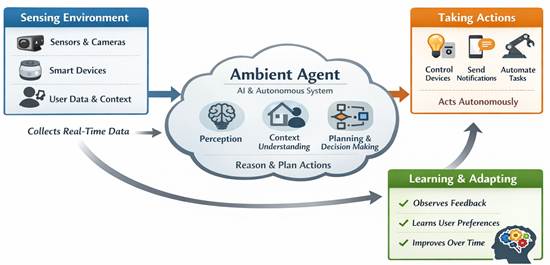
For a CXO, this means that routine but high-volume responsibilities can increasingly be executed with minimal manual intervention, while still remaining within defined governance boundaries. Emails can be interpreted, drafted, prioritized, and responded to based on intent, urgency, stakeholder sensitivity, and the executive’s historical communication patterns. Microsoft Teams conversations can be continuously monitored, triaged, acknowledged, summarized, or escalated depending on business context, decision criticality, and organizational hierarchy. Similarly, approval workflows can be assessed against enterprise policies, financial thresholds, risk indicators, compliance requirements, and historical decision patterns before the agent generates a recommendation—or, where predefined confidence and authority limits are met, executes an automated decision with a complete audit trail.
Importantly, autonomy here does not imply the absence of control. Ambient agents operate with explicit guardrails: confidence thresholds, audit trails, explainability, and human-in-the-loop mechanisms ensure that accountability remains firmly with the executive, while execution becomes faster and more predictable.
From Executive Assistants to Ambient Decision Partners
What makes ambient agents fundamentally different from traditional digital assistants is persistence and situational awareness. Rather than responding only when prompted, these agents continuously monitor signals across emails, meetings, dashboards, collaboration platforms, and enterprise systems. Over time, they build a working model of executive intent.
For example, an ambient agent supporting a CIO might recognize patterns such as recurring security exceptions, delayed vendor approvals, or cost overruns in specific programs. Instead of merely reporting these issues, the agent can proactively prepare decision briefs, suggest approvals within limits, or flag anomalies that require immediate attention.
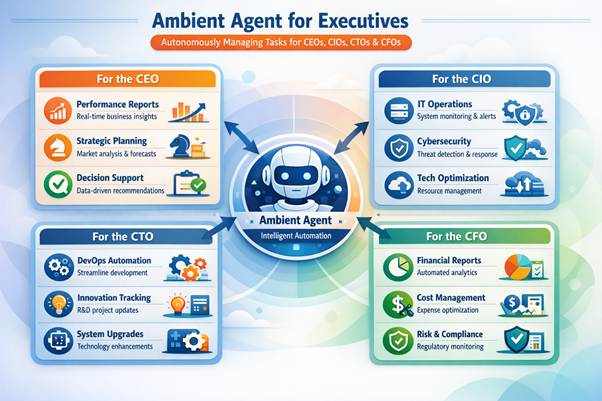
Looking ahead, the CXO of the future will not lead alone. They will be surrounded by a constellation of AI agents
As these agents mature, their role shifts from “helping” to “anticipating.” They become capable of coordinating across multiple assisted agents—one focused on communication, another on governance, and a third on analytics—acting together as a digital executive office that scales with the complexity of the enterprise.
Role-Specific Evolution: CEO, CTO, and CIO in an Agent-Driven Future
While the underlying agent framework may be shared, the way ambient agents support each CXO role differs significantly.
For a CEO, the emphasis is on strategic alignment and external communication. Ambient agents can synthesize market signals, investor sentiment, and internal performance indicators to continuously refine executive talking points. They can draft board updates, respond to stakeholder queries, and highlight strategy deviations early enough for corrective action.
The CTO’s agents, on the other hand, focus on architectural coherence and innovation velocity. Assisted agents can review design proposals against reference architectures, flag technical debt risks, and even recommend modernization priorities based on system telemetry and incident trends. Over time, this enables the CTO to shift attention from reactive firefighting to intentional technology leadership.
For the CIO, ambient agents become guardians of operational rhythm and governance. They can autonomously handle routine approvals, review compliance evidence, respond to audit queries, and manage communication across IT leadership forums. By absorbing operational noise, these agents allow the CIO to concentrate on value realization, digital resilience, and cross-business alignment.
Automating CXO Responsibilities with Ambient AI Agents
The following table illustrates how different CXO roles can be augmented by ambient and assisted agents, along with representative tasks that can be partially or fully automated.
| CXO Role | Focus Area | Example Tasks Automated by AI Agents |
| CEO | Strategy & External Alignment | Drafting investor communications, summarizing board materials, responding to high-level stakeholder emails, monitoring strategic KPIs and exceptions |
| CIO | IT Strategy & Governance | Approval of standard IT requests, compliance evidence review, Teams message triage, audit response preparation, operational risk notifications |
| CTO | Architecture & Innovation | Design review against standards, technical risk assessment, modernization recommendations, and engineering decision summaries |
| CFO | Financial Oversight | Expense and budget approvals within thresholds, financial variance analysis, review of forecast assumptions, audit trail generation |
| COO | Operations & Execution | Monitoring operational metrics, decision routing for escalations, vendor performance analysis, exception handling recommendations |
| CHRO | Workforce & Talent | Policy-compliant approvals, employee communication drafts, workforce analytics summaries, compliance checks |
| CISO | Security & Risk | Incident prioritization, approval of standard exceptions, response drafting for audits and regulators, continuous risk posture updates |
This table reflects a broader trend: CXO roles are not being replaced, but increasingly “industrialized” through standardized decision patterns executed by trusted AI collaborators.
Monetizing Skill and Ambient Agents
The monetization of skill and ambient agents is likely to emerge as a major enterprise AI value stream, particularly as organizations move from experimental copilots to governed, role-specific agent ecosystems. In this model, reusable skill templates become the commercial and operational unit of value. A skill template that can evaluate an IT approval, generate a board-ready summary, validate a design decision, or assess a financial exception is not merely a productivity feature; it is a codified executive capability that can be packaged, versioned, governed, and reused across business units.
For technology providers, this creates opportunities to offer agent marketplaces where certified skill templates are distributed as configurable assets. These templates may be monetized through subscription models, usage-based pricing, outcome-based pricing, or enterprise licensing. For example, a CFO approval agent could be priced based on transaction volume, while a CIO governance agent may be licensed as part of an enterprise risk and compliance suite. Over time, organizations may also develop internal agent economies, where high-performing templates created by one function are reused by others, reducing duplication and accelerating AI adoption. From an enterprise perspective, monetization should not be viewed only as external revenue generation. The more immediate value lies in cost avoidance, productivity gains, cycle-time reduction, compliance improvement, and decision consistency. Ambient agents can minimize approval delays, increase responsiveness among dispersed teams, and lessen executive reliance on manual coordination. More advanced monetization models may link agents directly to measurable outcomes, such as reduced cloud spend, faster audit closure, lower operational risk, or improved customer response time.
However, successful monetization requires strong governance. Skill templates must include ownership, lifecycle management, validation metrics, access controls, and auditability. As agent ecosystems mature, the most valuable organizations will be those that treat executive decision patterns as strategic intellectual property, capable of being automated, measured, improved, and monetized at scale.
Challenges in Ambient Agents
While ambient agents offer significant promise, their adoption introduces a complex set of technical, organizational, and governance challenges. The first major challenge is context fidelity. Ambient agents depend on continuous access to fragmented signals across emails, meetings, collaboration platforms, enterprise applications, data lakes, workflow systems, and operational dashboards. If these signals are incomplete, outdated, or semantically misinterpreted, the agent may produce recommendations that appear confident but are misaligned with executive intent. Ensuring high-quality context, therefore, becomes a foundational requirement.
A second challenge is decision accountability. Unlike traditional automation, ambient agents operate persistently and may initiate actions without explicit prompts. This raises critical questions around authority, escalation, liability, and explainability. CXO-level decisions often involve ambiguity, political sensitivity, regulatory exposure, or reputational risk. As a result, organizations must clearly define which actions can be fully automated, which require human approval, and which must remain outside the agent’s operating boundary.
Security and privacy risks are also amplified. Ambient agents may have access to sensitive board materials, financial forecasts, employee data, legal correspondence, and strategic plans. Poor identity management, excessive permissions, prompt injection, data leakage, or compromised integrations could create significant enterprise exposure. Therefore, agentic systems require zero-trust access models, fine-grained authorization, continuous monitoring, encryption, and robust audit trails.
Another challenge is behavioral drift. As agents learn from executive preferences and organizational patterns, they may gradually reinforce outdated behaviors, biases, or informal exceptions. Continuous validation, model evaluation, policy alignment, and template version control are essential to prevent uncontrolled evolution.
Finally, cultural adoption cannot be underestimated. Executives must trust the agent without becoming overly dependent on it. The goal is not to outsource leadership judgment, but to augment it. Ambient agents will succeed only when organizations combine technical capability with disciplined governance, transparent controls, and a clear understanding of where human judgment remains indispensable.
Redefining Executive Work, Not Replacing It
As ambient agents take on more execution-oriented responsibilities, the nature of executive work evolves. Time shifts away from processing information toward interpreting it. CXOs devote more time to dealing with the exceptional and less time to approving the anticipated. Leadership becomes less about managing volume and more about shaping direction, culture, and intent.
The most successful organizations will treat ambient agents as part of their leadership architecture. This means investing not only in technology, but also in governance models, ethical guardrails, and clear definitions of decision ownership. Skill templates must be curated with the same rigor applied to financial controls or enterprise architectures.
Looking ahead, the CXO of the future will not lead alone. They will be surrounded by a constellation of AI agents—quietly attentive, context-aware, and action-oriented—working in the background to ensure that decisions are timely, informed, and consistently aligned with enterprise goals. In this partnership between human judgment and machine intelligence lies the next evolution of executive leadership.