

From Headlines to Evidence: Measuring the True Impact of AI on Workforce Restructuring
By Sandeep Rangarajen, Risk Management professional with a leading global investment Bank and Nirvik Banerjee, Risk Analytics professional with a leading global Bank
Abstract
Artificial Intelligence (AI) has become one of the biggest forces reshaping the global workforce and is regarded as the most significant technology disruption in human history, often referred to as the Fourth Industrial Revolution. While its predecessor democratized information and data exchange, AI significantly moves up the value chain by working on cognitive processing and fundamentally reshaping the approach to modern day problem solving.
The advent of AI presents a nuanced reality: It is simultaneously eliminating certain tasks, transforming existing roles, and creating demand for new skills and occupations.
The wave of corporate restructuring sweeping Fortune 500 companies 1in the recent past has been widely attributed to AI — yet the attribution itself remains poorly disaggregated, and the lived experience of affected workforces is more cyclical and contradictory than the headline narratives.
Is the restructuring triggered due to AI-induced redundancy, or because organizations need to free up capital to fund AI investments? This is an important distinction as it provides a larger lens to analyse whether concerns regarding an AI-driven employment apocalypse are warranted or whether the labour-market impact of AI has been overestimated.
This article proposes a data-driven framework for decomposing restructuring into its probable underlying causes using publicly available information—including filings, disclosures, financials, market expectations, etc. The objective is to move the discussion from headlines and anecdotes toward measurable evidence, backed by data.
The question is no longer whether AI is changing the workforce, but whether it can be quantified.
Rise of the AI restructuring narrative
Workforce restructuring is not new. Organizations have long optimized headcount in response to changing business conditions, productivity initiatives, acquisitions, and shareholder expectations. What has changed is the language used to explain these decisions. Today, they are increasingly linked to AI.
The phrases have become familiar to the point of formula:
| “We are becoming an AI-first company.” “We are restructuring to align with our AI strategy.” “We are simplifying the organisation to accelerate AI innovation.” |
As of mid-2026, more than 113,000 technology workers have been laid off across nearly 180 companies. At the same time, the world’s largest technology firms have committed over $700 billion toward AI infrastructure, data centres, specialised chips, and model development. Restructuring announcements frequently reference AI-driven productivity gains, efficiency improvements, and the need to accelerate AI investments and it is this coexistence that creates the impression of causation. This is increasingly becoming contagious to other sectors as well.
This points us to a major attribution issue – If AI has become the dominant explanation, how do we know how much of restructuring is actually attributable to AI?”
The Shift in Corporate Language
Our full-text analysis of 10-K filings from FY2020 to FY2024 across 46 Fortune 500 and leading listed companies in FMCG, Financial services, Financial technology (Fintech), Manufacturing and Technology confirms an accelerating and consistent pattern. Across all 5 sectors, AI mention frequency roughly doubled or tripled between FY2022 and FY2024 alone.
This linguistic evolution is not evidence of AI-washing in itself. It may simply reflect the growing materiality of AI as a business risk and strategic priority.
| The question is whether the investment backing the narrative keeps pace with the narrative itself — and whether the narrative is being used to explain workforce decisions that have other primary causes |
As AI has become the dominant corporate narrative, a new question has emerged: are organisations always describing workforce restructuring accurately, or is it being reframed through the language of AI transformation?
The AI-Washing Hypothesis
As AI has become the dominant corporate narrative, a new question has emerged: are organisations always describing workforce restructuring accurately, or is it being reframed through the language of AI transformation?
The possibility is not surprising. Most executives face pressure to demonstrate strategic relevance in an AI-driven market. Investors are naturally inclined towards rewarding organisations perceived to be leading in AI adoption. In this environment, positioning a restructuring programme as part of an AI transformation strategy could be more compelling than describing it as a conventional cost reduction or margin improvement initiative.
This creates the potential for what some commentators have termed “AI-Washing”—the tendency to overstate the role of AI in organisational decisions relative to its actual operational impact.
AI-Washing may reflect the growing tendency to bundle multiple objectives—including productivity improvement, cost optimisation, organisational simplification, and AI investment—under a single AI transformation narrative.
This basically consists of two attributes
- Technology Transformation Intensity – representing the scale of technology and AI investment.
- Workforce Attribution Intensity – representing the extent to which organisations attributed workforce actions to AI.
Empirical Assessment: The Workforce Transition Framework
To deep dive into the probable workforce transition, we built a systematic scoring tool grounded entirely in public filings — applied consistently across 46 Fortune 500 and leading listed companies spanning Manufacturing, Financial services, Fintech, Technology, and FMCG over five fiscal years.
Each company is assessed across 18 variables in five domains:
- Business Performance — Revenue growth, net income trajectory, and a demand-headwind flag coded from MD&A language.
- Workforce Action — Headcount change, restructuring charge intensity, programme recurrence, and divestiture flags.
- Technology & AI Investment Intensity — R&D and technology spend as a share of revenue, capital expenditure, and AI and automation mention frequency extracted from full filing text.
- Disclosure & Attribution — A 1-to-5 Attribution Directness Score, number of mentions from restructuring footnotes, MD&A, and communications: 1 = AI mentioned in passing elsewhere in the filing; 3 = AI cited in a press release or statement for the specific cuts/years; 5 = publicly quantified number of roles to be impacted by AI.
- Outcome Verification — Revenue per employee before and after each restructuring and efficiency ratio or EBITDA target versus subsequent actual results
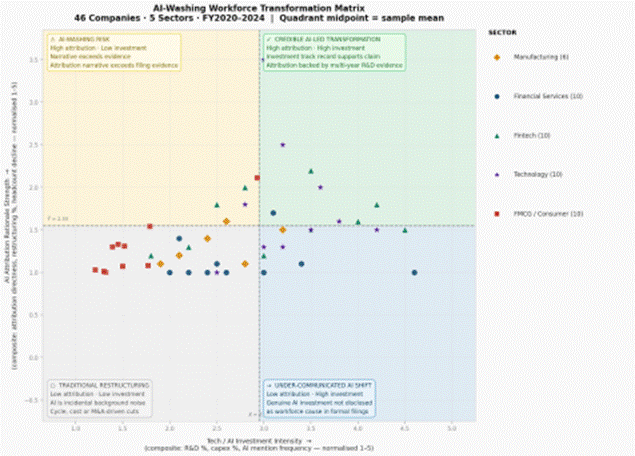
How the scoring works: Each variable is normalised on a 1–5 scale using min-max standardisation within sectors. Two composite scores are then computed per company — Investment Intensity (X-axis) and Attribution Rationale Strength (Y-axis) — by averaging the normalised component scores within each axis. The gap between X and Y is the measurable AI washing signal: a company scoring high on attribution and low on investment has more to explain than one where both move together.
Key Findings
Across 46 companies and five sectors, no single factor consistently explains workforce restructuring. AI attribution is rarer, and harder to defend, than the volume of AI-related announcements suggests.
Technology is the only sector where formal AI attribution reaches the highest level. Most of the companies are hovering in the credible AI led transformation quadrant.
Finance presents the sharpest paradox. Most firms undergo traditional restructuring, with some resorting to underreporting. The sector invests most and discloses least.
Fintech contains the study’s clearest AI-washing signal. Most companies are divided between credible AI lead transformation and AI washing.
Manufacturing shows narrative outpacing investment. AI mention frequency tripled between 2022 and 2024, yet no manufacturer formally attributed AI as a restructuring lever in a 10-K filing.
FMCG anchors the bottom of both axes, with a score of 3/5 representing the sector ceiling.
AI-washing risk and its inverse coexist. In manufacturing and parts of fintech, AI language has outpaced verifiable investment — the narrative precedes the evidence. In financial services, the opposite holds: the sector invests most heavily in technology yet discloses least about its connection to workforce decisions. Both patterns create information gaps that investors and policymakers cannot currently bridge from public filings alone.
Disclosure standards have not kept pace. A company can announce thousands of job cuts under an AI transformation banner and file a 10-K the same year attributing those cuts to organisational simplification. The SEC’s Human Capital requirements2 do not require disaggregated attribution of headcount changes to specific causes. Note: AI and automation mention counts are estimated from known disclosure patterns rather than full machine-counted text, and attribution directness scores involve judgment. Findings are indicative rather than statistically confirmatory.