
Building Trust in the Age of AI in Healthcare
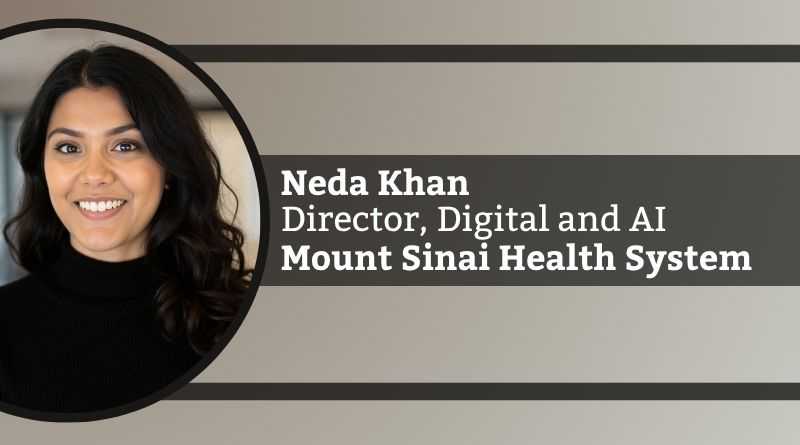
By Neda Khan , Director, Digital and AI Experience, Mount Sinai Health System
I didn’t start my career thinking about artificial intelligence. I started it thinking about people. Specifically, why they make the health decisions they do, and how you design systems that meet them where they are. From building and launching remote monitoring programs that reached over two million patients at Penn Medicine, to leading behavioral economics research at the University of Pennsylvania’s Nudge Unit, to commercializing emerging digital health technologies at Cleveland Clinic, every role I’ve held has orbited the same core question: how do you get people to trust something new enough to change their behavior?
That question has never felt more urgent than it does right now, as health systems across the country navigate the rapid adoption of AI. And what I’ve observed across institutions, across roles, across the patients and clinicians I’ve worked alongside for over a decade, is that the technology is rarely the hardest part. The hardest part is trust.
AI in Healthcare Is Moving Faster Than the Humans Inside It
The pace of AI adoption in health systems has accelerated rapidly. Two years ago, these tools were experimental. Today, they are being widely used in call centers, clinical documentation, diagnostic support, patient communication, and other areas. The promise is real: reduced administrative burden, faster access to information, more consistent care.
But across the industry, a pattern keeps emerging. After investing in potent AI tools and conducting successful pilot programs, health institutions encounter difficulties when attempting wider implementation. Clinicians use the tools inconsistently. Patients interact with AI-powered touchpoints with skepticism or confusion. Frontline staff worry about what these systems mean for their roles. The technology is ready. The organization is not.
This is the trust gap. And it is the defining challenge of AI adoption in healthcare today.
AI is not coming to healthcare. It is already here. The question facing health system leaders is not whether to engage, but how thoughtfully they do so.
What the Trust Gap Actually Looks Like
The trust gap shows up differently depending on who you’re talking to.
For patients, it often surfaces as uncertainty. When a health system deploys an AI-powered voice agent in its call center, a system capable of handling scheduling, answering common questions, and navigating care access workflows, patients need more than a functional tool. They need to feel heard. They need to know that if something goes wrong, or if their situation is complicated, a human being is still reachable. Without that assurance built into the design, even a technically excellent system can feel cold, opaque, or untrustworthy.
For clinicians, the trust gap looks like skepticism about ROI. When Ambient AI, which is a tool that listens to patient-provider conversations and automatically generates clinical documentation, gets introduced into a busy physician’s workflow, the instinctive question is not “how does this work?” It is “does this actually save me time”, or “does it create more work to review and correct?” Clinicians are trained to question. They are not going to change deeply ingrained documentation habits because an administrator asked them to. They need evidence, from people they respect, that the tool delivers on its promise.
For frontline staff, the trust gap can manifest as fear. Fear about displacement, about accountability, about what happens when the AI makes a mistake. Who owns that outcome? These are not irrational concerns. They deserve honest answers.
Change Management Is Not a Soft Skill — It’s a Strategy
What I’ve seen work, across organizations that have navigated AI adoption well, is a commitment to treating change management with the same rigor applied to technical implementation. That means starting early. Not at go-live, but months before and involving end users in shaping how the tool gets introduced into their environment.
Listening sessions matter. When staff are invited to name their fears before a deployment, rather than discovering their concerns aren’t being addressed after one, something shifts. They move from passive recipients of change to active participants in it. That shift is not cosmetic. It affects adoption, it affects how problems get surfaced and solved, and it affects whether the investment actually delivers.
Champions matter even more. Peer influence in healthcare is powerful and underutilized in technology rollouts. When a respected colleague stands in a department meeting and says, “this genuinely changed how I work today,” it carries more weight than any executive communication. Health systems that identify and invest in champions early see better adoption outcomes meaningfully.
And perhaps most importantly: honesty matters. AI tools in healthcare are not perfect. They generate errors. They perform inconsistently across patient populations. Overselling them erodes exactly the trust you need to build. Organizations that acknowledge limitations openly, and pair that honesty with clear protocols for human oversight and escalation, build more durable confidence than those that lead with hype.
The Positive Impact — and the Honest Risks
Where trust has been earned and adoption has taken hold, the impact is real. AI-powered call center tools are reducing wait times and freeing human agents to focus on the complex, emotionally sensitive calls that require judgment no algorithm can replicate. Ambient AI is giving clinicians back time. And in a profession where burnout is a patient safety issue, not just an HR metric, that matters enormously.
But the risks deserve equal attention. AI systems can fail in ways that are harder to detect than traditional software errors, and in healthcare, the stakes of a missed error are uniquely high. Automation bias, which is the tendency to defer to AI outputs without adequate scrutiny, is a real and documented phenomenon. And equity cannot be an afterthought: if AI tools perform differently across patient populations, deploying them at scale without ongoing bias monitoring is not innovation. It is risk amplification.
What the Industry Needs to Get Right
AI is not coming to healthcare. It is already here. The question facing health system leaders is not whether to engage, but how thoughtfully they do so.
Start with the humans, not the technology. Invest in learning what frontline employees need to feel valued, what patients need to feel protected, and what clinicians need to feel supported. Build transparency into AI systems by design, not as a legal disclaimer, but as a feature. Measure trust, not just efficiency. Patient experience, staff adoption rates, and qualitative feedback are as important as throughput metrics.
The health systems that will lead in this era are not necessarily those with the most sophisticated models or the largest AI budgets. They are the ones who take the time to bring their people along and earn the trust that makes transformation sustainable.