
The Future of CIO Leadership: Trust, Ethics, and People-First Strategy in a Rapidly Changing Tech Landscape
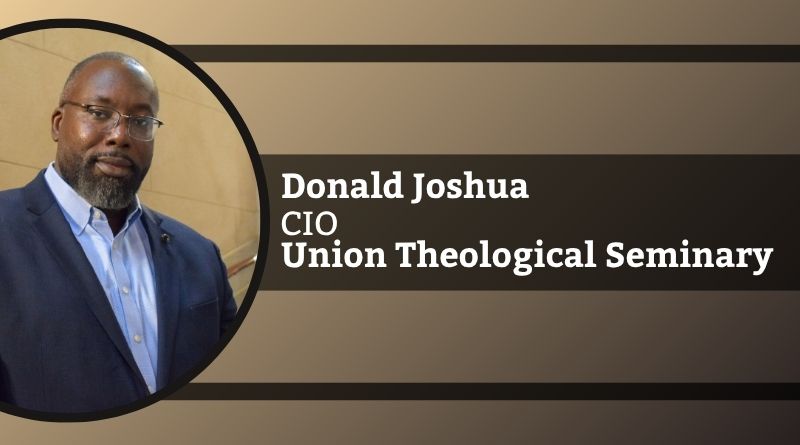
By Donald Joshua, CIO, Union Theological Seminary
As AI accelerates across every sector, CIOs face a defining leadership moment. Mission-driven institutions offer a powerful model for navigating this shift by staying grounded in trust, ethics, and people-centered transformation. In environments where technology directly impacts the daily lives of students, faculty, and staff, CIOs must lead with transparency, engage stakeholders early, and prioritize systems that strengthen community while driving institutional goals and objectives.
Technology leaders can share valuable lessons through a stewardship mindset: prioritizing foundational infrastructure, strategically phasing investments, and forging institutional collaboration models and cross-sector partnerships to expand capability.
The life of a modern CIO requires embracing a vital duality, staying informed and engaged with industry advancements and best practices, while serving people, protecting dignity, and reinforcing institutional purpose amid sweeping digital change. As we navigate the critical questions of what emerging institutional technology can do, what it should do, and whom it serves, the path forward demands both technical vision and human-centered leadership.
Trust as the Cornerstone of Modern CIO Leadership
Highlighting the idea of trust and a servant-leader mindset in practical application offers benefits that extend far beyond what some may dismiss as a Pollyanna-ish outlook or merely a trait revealed in a CliftonStrengths assessment. In today’s environment, where digital transformation is accelerating and artificial intelligence is reshaping how institutions operate, trust becomes the stabilizing force that allows organizations to move forward with confidence rather than fear. People are not simply skeptical about technology; they are uncertain about what these advancements may mean for their dignity, their roles, and their place in the institution’s future.
This is precisely why CIOs must lead with transparency that goes deeper than inspirational messaging. As CIOs, we must show our community that technology is not being imposed upon them in an authoritarian, take-it-or-leave-it approach, but it is being shaped with them and aligned with the broader shared strategic mission of the institution.
Trust transforms skeptics into contributors, stakeholders into partners, and significant projects into chances for the community’s overall development.
Change moves at the speed of trust
Stephen Covey
Ethics at the Core of Digital Transformation
Several years ago, as an executive leader, I was recommended the book “The Technology Fallacy: How People Are the Real Key to Digital Transformation” by Gerald C. Kane, Anh Nguyen Phillips, and their colleagues. The insights in this work deeply informed my own leadership philosophy, especially as ethics in technology has become front and center, most notably in the ongoing conversation surrounding artificial intelligence. For many of us, our daily work sits at the intersection of institutional values and technological capability.
The importance of responsible governance frameworks that ensure fairness, transparency, and accountability has never been more urgent. Ethical stewardship requires examining not only the operational benefits of new systems, but also their broader social and human implications, an emphasis that is a central through line of the aforementioned book.
Technology should reinforce dignity, protect privacy, reduce inequity, and enhance people’s ability to do their best work. Organizations and their leaders can foster a culture where ethics and creativity coexist and become ingrained in the institution’s DNA by modeling these ideals repeatedly. The alternative, a more performative, bolt-on approach to ethics, deployed only when convenient or when cameras are present, will inevitably fail. In the long run, authenticity, transparency, and principled decision-making will always prove to be the more sustainable and credible path forward.
The Duality of CIO Leadership in the Age of AI
The life of a modern CIO will increasingly require embracing the duality of maintaining a strong technical vision while embodying a human-centered leadership approach. We must stay deeply informed and engaged with emerging technologies while simultaneously protecting dignity, centering humanity, and reinforcing institutional purpose. There will be moments when circumstances force us to lean more heavily in one direction, but maintaining a foothold in both domains is essential. That balance is a defining characteristic of contemporary CIO leadership.
Through the recently established IT & Digital Innovation (ITDI) Committee, our institution has made a determined effort to represent this duality. This committee is intentionally designed to remove silos within the departmental structure and in how we discuss technology. By bringing together cross-functional perspectives, we are better equipped to evaluate emerging capabilities, understand institutional readiness, and prioritize systems that strengthen collaboration rather than operate in isolation. This approach helps us avoid the familiar trap of chasing technology for its own sake, instead ensuring that every decision aligns with institutional strategy and community need.
CIOs today must evaluate new capabilities with clarity and discipline, without losing sight of the people and processes they affect. We must cultivate departmental technology partners capable of rapid experimentation while ensuring that security, compliance, accessibility, and long-term sustainability remain uncompromised. We must always keep the mission, culture, and trust at the forefront of everything we do.
AI and digital transformation introduce extraordinary opportunities, but they also require intentional governance, rigorous risk management, and a commitment to equitable outcomes. The future of institutional success will be determined by CIOs who accept this dichotomy in technical vision combined with human-centered leadership.
Looking Ahead
It is no coincidence that at the recent EDUCAUSE conference, many of my conversations with fellow CIOs centered on themes deeply rooted in collaboration and the shared responsibility of shaping digitally resilient institutions. While AI was predictably at the forefront of many presentations, there was a notable and refreshing shift toward balancing innovation with humanity, ensuring that technological progress does not eclipse the lived experiences of our campus communities.
And for CIOs working outside higher education or the nonprofit sector, these conversations remain highly relevant. Finding small, practical ways to implement these principles, whether through transparent decision-making, inclusive design practices, or intentional capacity-building, can yield significant long-term dividends. These actions influence not just the success of technology initiatives but also the degree to which stakeholders feel empowered, respected, and ready to embrace change.
Ultimately, the future of digital leadership is not defined by the sophistication of our tools, but by the strength of the trust we cultivate and the humanity we preserve in the process.