

Cloud Repatriation Reimagined: Building a Cost-Optimized, Sovereign, and Workload-Aware Hybrid Future
By Dr. Anand Nayyar, Full Professor, Scientist, Vice-Chairman (Research) and Director (IoT and Intelligent Systems Lab), Duy Tan University and Dr. Magesh Kasthuri, Chief Architect and Distinguished Member of Technical Staff
Cloud repatriation has moved from being a reactionary cost-cutting measure to a thoughtful infrastructure strategy. A few years ago, the public cloud was widely treated as the default destination for almost every modernization program. Today, the conversation is more measured. Enterprises are now asking whether a workload is appropriate for which operational environment, at what cost, under what governance model, and with what long-term control, rather than whether cloud computing is good or bad. This shift reflects a broader maturity in cloud adoption. Organizations have gained enough operational experience to understand that the cloud is powerful, but not automatically optimal for every application, data platform, or business process.
Cloud repatriation refers to the movement of selected workloads, applications, datasets, or infrastructure services from public cloud environments back to on-premises data centers, private cloud platforms, sovereign environments, colocation facilities, or hybrid architectures. It is not a rejection of cloud computing. Rather, it is a course correction aimed at aligning infrastructure placement with workload behavior, regulatory expectations, performance requirements, application economics, and organizational risk tolerance.
1. Why Cloud Repatriation Is Becoming a Strategic Trend
The cloud-first era helped enterprises accelerate digital transformation, scale rapidly, and experiment without heavy upfront investment. However, many organizations are now discovering that cloud economics change significantly once workloads stabilize, data volumes grow, and usage patterns become predictable. What was once an elastic innovation platform can become an expensive operating model if workloads are left unmanaged, overprovisioned, or tightly coupled to proprietary services.
Recent industry discussions show that repatriation is increasingly connected to cost optimization, hybrid cloud modernization, digital sovereignty, governance, and AI workload placement. Gartner has highlighted that hybrid cloud is being reshaped by converging trends such as generative AI, digital sovereignty, cost optimization, and governance, while other market analyses indicate that many enterprises are moving only selected workloads rather than abandoning public cloud altogether. This makes the trend more nuanced than the phrase “moving back on-premises” suggests.
The most mature organizations are shifting from a cloud-first mindset to a cloud-appropriate mindset. In this model, public cloud remains valuable for innovation, burst capacity, global reach, managed services, analytics experimentation, and software-as-a-service integration. At the same time, private or on-premises environments may be preferred for steady-state applications, predictable compute, latency-sensitive workloads, regulated data, and specialized AI infrastructure where unit economics and control matter more than raw elasticity.
Public cloud will continue to play a major role in enterprise technology, but it will increasingly coexist with private cloud, sovereign infrastructure, colocation, edge, and hybrid models
2. Key Trends Shaping Cloud Repatriation
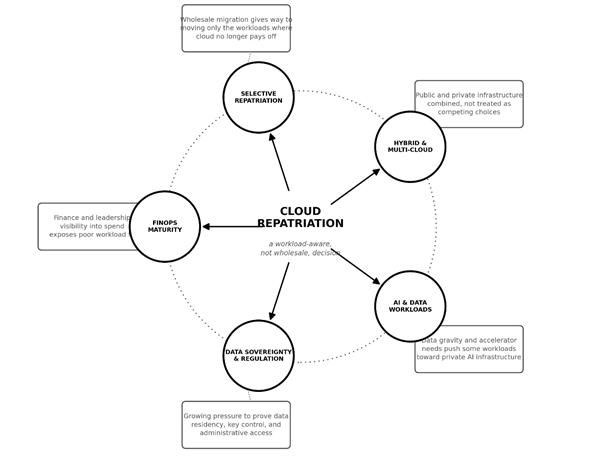
Selective repatriation is replacing wholesale migration. Enterprises are rarely moving everything out of the public cloud. Instead, they are identifying workloads where cloud consumption no longer delivers proportional business value. Production databases, archival storage, high-volume data pipelines, backup repositories, virtual desktop estates, and predictable enterprise applications are common candidates for repatriation or hybrid redesign.
Hybrid and multi-cloud operating models are becoming the practical middle path. Rather than treating public cloud and private infrastructure as competing choices, organizations are combining them. A hybrid model allows sensitive or predictable workloads to run in controlled environments while innovation workloads, customer-facing platforms, and elastic services continue to benefit from public cloud capabilities.
AI and data-intensive workloads are changing placement decisions. Generative AI, machine learning, simulation, and analytics workloads require large datasets, specialized accelerators, and reliable data movement. When data gravity increases, the cost and complexity of moving information repeatedly across regions, clouds, and networks can outweigh the benefits of cloud elasticity. This is pushing some enterprises to consider private AI clusters, GPU farms, or colocated high-performance environments.
Data sovereignty and regulatory assurance are becoming business priorities. Industries such as banking, insurance, healthcare, telecom, public sector, and critical infrastructure face growing pressure to prove where data resides, how encryption keys are managed, who has administrative access, and how exit plans are exercised. Repatriation often becomes part of a broader sovereignty and resilience strategy, especially when regulatory expectations exceed what a generic public cloud configuration can demonstrate.
FinOps maturity is exposing poor workload fit. Cloud bills are no longer hidden inside IT operations. They are now reviewed by finance, procurement, product owners, and executive leadership. Organizations may identify which workloads are underutilized, which services result in erratic charges, and which architectural decisions result in unnecessary spending as FinOps processes advance. This visibility often triggers repatriation assessments.
3. New-Age Problems Driving Repatriation Decisions
The current repatriation wave is not caused only by high monthly invoices. Newer problems are emerging from the way modern applications interact with data, compliance boundaries, AI infrastructure, and platform services. One major issue is data gravity. As enterprises create larger data lakes, observability repositories, AI training datasets, and customer intelligence platforms, data becomes harder and costlier to move. When workloads necessitate frequent cross-region or cross-cloud data transfers, applications naturally start to cluster around the data, which can make public cloud architectures costly.
Another new-age concern is architectural lock-in. Many cloud-native systems are built using proprietary identity services, serverless runtimes, managed databases, event platforms, monitoring tools, and automation APIs. These services improve speed in the short term but can make exit planning difficult. The more deeply an application depends on provider-specific features, the more expensive and riskier repatriation becomes later.
AI workloads add another layer of complexity. Public cloud provides quick access to advanced AI services and accelerators, but predictable model training, inference at scale, data privacy constraints, and accelerator availability can change the economics. Some enterprises are beginning to evaluate private AI infrastructure not because cloud AI is unsuitable, but because long-running, high-throughput use cases need greater cost predictability and control.
Operational fragmentation is also becoming visible. Many organizations now operate public cloud, private cloud, software-as-a-service platforms, edge environments, and legacy data centers at the same time. Without a unified operating model, this creates inconsistency in security controls, incident response, patch management, monitoring, backup, cost allocation, and compliance reporting. Repatriation may therefore be used to simplify the estate, but only when it is accompanied by modernization and governance discipline.
4. Cost Implications of Cloud Repatriation
Cost is the most visible driver of repatriation, but it must be examined carefully. A cloud bill is not equivalent to the true cost of cloud, and an on-premises invoice is not equivalent to the true cost of repatriation. A fair comparison must include infrastructure, facilities, power, cooling, network connectivity, security tooling, software licensing, people, support contracts, depreciation, disaster recovery, backup, hardware refresh cycles, and operational risk.
Cloud cost pressure often comes from several sources: compute instances that remain overprovisioned, storage tiers that are not optimized, snapshots and backups that accumulate over time, cross-region replication, outbound data transfer, logging growth, premium managed services, unused reservations, and lack of workload scheduling. In data-heavy environments, egress charges and inter-region traffic can become especially painful because they are not always obvious during initial architecture planning.
Repatriation may reduce recurring cloud consumption costs for stable workloads, but it introduces transition costs. These include assessment, migration tooling, refactoring, hardware procurement, network redesign, data transfer, parallel run periods, testing, security validation, training, and possible downtime mitigation. The business case should therefore compare not only run-rate savings but also payback period, total cost of ownership, opportunity cost, and operational resilience.
A practical rule is to repatriate only when the workload characteristics justify the move. Predictable utilization, high data transfer cost, strong compliance constraints, low need for elasticity, stable architecture, and clear ownership usually strengthen the case. Conversely, workloads with volatile demand, rapid feature experimentation, global scaling needs, or heavy dependency on managed cloud services may remain better suited to public cloud.
5. Common Roadblocks in Cloud Repatriation
Cloud repatriation can fail when it is treated as a simple infrastructure relocation. Moving workloads back without redesigning operating processes, network flows, security controls, or platform dependencies often transfers the same inefficiencies into a different environment. The most common roadblocks appear at the intersection of technology, finance, governance, and organizational readiness.
Incomplete workload discovery is a significant barrier. Many estates contain undocumented dependencies, hidden data flows, hard-coded endpoints, licensing constraints, and operational scripts created over years. Another challenge is skills readiness. Teams that have spent years consuming managed cloud services may not immediately have the expertise to operate databases, middleware, observability stacks, high-availability clusters, and security tooling in private environments.
Business continuity is also a serious concern. Repatriation normally requires migration windows, replication planning, rollback procedures, performance baselines, and stakeholder communication. If the move is rushed, the organization may experience service degradation, compliance gaps, or user disruption. For regulated enterprises, evidence generation is equally important. Auditors and regulators may expect proof that controls remain effective before, during, and after the transition.
| Roadblock | Why It Matters | Solution Approach |
| Incomplete workload inventory | Unknown dependencies can cause migration delays, outages, or missed integrations. | Run automated discovery, dependency mapping, network flow analysis, and application owner workshops before finalizing scope. |
| Hidden cloud-native dependencies | Managed services, proprietary APIs, and serverless components can be difficult to reproduce outside the cloud. | Classify dependencies by portability risk and use refactoring, containerization, open standards, or equivalent private platform services where justified. |
| Weak business case | Run-rate savings may be overstated if transition, staffing, licensing, and hardware refresh costs are ignored. | Build a full TCO model covering migration cost, payback period, operational cost, depreciation, risk, and opportunity cost. |
| Skills and operating model gaps | Teams may lack experience in operating private cloud, storage, networking, databases, and observability platforms at scale. | Create a capability plan covering training, managed services, automation, SRE practices, and clear ownership boundaries. |
| Security and compliance uncertainty | Controls may not translate directly from public cloud to private infrastructure. | Redesign identity, encryption, logging, key management, backup, vulnerability management, and audit evidence processes early. |
| Data migration complexity | Large datasets can take significant time to move and may incur transfer costs or synchronization challenges. | Use phased replication, compression, deduplication, transfer appliances, data lifecycle cleanup, and well-tested cutover procedures. |
| Performance unpredictability | Applications may behave differently in new network, storage, and compute environments. | Capture baselines, run performance tests, tune infrastructure, and conduct pilot migrations before broad execution. |
| Business disruption risk | Poorly planned cutovers can affect customers, employees, partners, or regulatory commitments. | Prepare rollback plans, communication playbooks, parallel run strategies, and phased go-live windows aligned with business criticality. |
6. Roadmap for Cloud Repatriation: A Phased Execution Framework
A successful cloud repatriation program requires a disciplined roadmap. The objective is not merely to bring workloads back, but to create a sustainable operating model that improves cost predictability, performance, compliance, and control. The following phased framework can help enterprises execute repatriation in a structured manner.
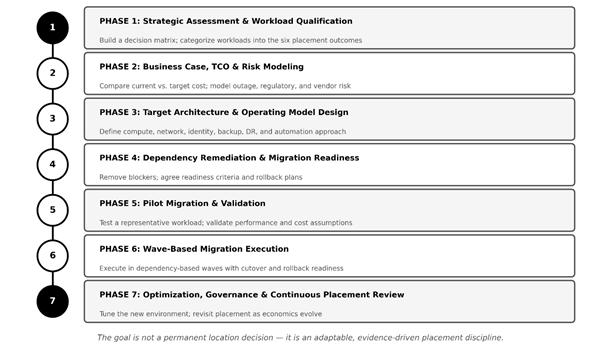
Phase 1: Strategic Assessment and Workload Qualification
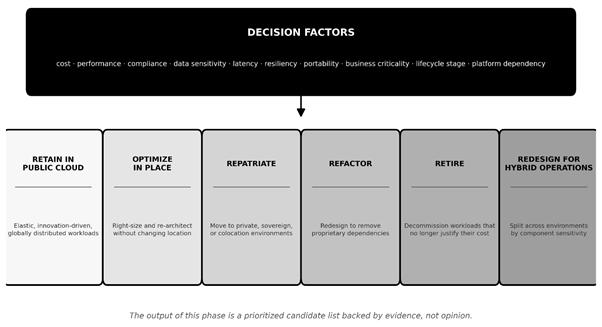
This phase establishes why repatriation is being considered and which workloads should be evaluated. The enterprise should create a decision matrix covering cost, performance, compliance, data sensitivity, latency, resiliency, portability, business criticality, lifecycle stage, and platform dependency. Workloads should be categorized as retain in public cloud, optimize in place, repatriate, refactor, retire, or redesign for hybrid operations. The output of this phase is a prioritized candidate list backed by evidence rather than opinion.
Phase 2: Business Case, TCO, and Risk Modeling
The business case must compare current cloud spending with the projected cost of the target environment. It should include compute, storage, network, licensing, facilities, support, automation, security, backup, disaster recovery, migration labor, and staff readiness. Risk modeling should address outage impact, regulatory exposure, vendor dependency, data transfer timelines, and modernization complexity. A credible business case should produce a clear payback period, financial assumptions, decision thresholds, and executive sponsorship.
Phase 3: Target Architecture and Operating Model Design
The target architecture should define where workloads will run, how users and systems will connect, how data will be protected, and how services will be monitored. This includes compute patterns, storage tiers, network segmentation, identity integration, encryption, secrets management, observability, backup, disaster recovery, patching, capacity management, and service-level commitments. A modern repatriation architecture should avoid recreating fragile legacy environments. Automation, infrastructure as code, policy enforcement, and self-service provisioning should be built into the design.
Phase 4: Dependency Remediation and Migration Readiness
Before migration begins, teams should remediate known blockers. This may include replacing proprietary services, redesigning integrations, cleaning unused data, updating DNS and network routes, validating licenses, strengthening security controls, and documenting operational runbooks. Application owners, platform teams, security teams, finance, compliance, and business stakeholders should agree on readiness criteria. Migration should not proceed until rollback plans, test cases, monitoring dashboards, and communication channels are in place.
Phase 5: Pilot Migration and Validation
A pilot migration reduces uncertainty. The pilot should involve a representative workload that is important enough to test real operational processes but controlled enough to limit business impact. During the pilot, teams should validate data integrity, application performance, failover behavior, security controls, user experience, support processes, and cost assumptions. Lessons learned from the pilot should be fed back into the migration factory before larger waves begin.
Phase 6: Wave-Based Migration Execution
Full execution should be organized into waves based on dependency groups, risk levels, application criticality, and business calendars. Each wave should include pre-migration checks, data synchronization, cutover planning, validation, rollback readiness, stakeholder communication, and post-migration stabilization. The migration team should track issues, benefits, cost changes, and control evidence continuously rather than waiting until the end of the program.
Phase 7: Optimization, Governance, and Continuous Placement Review
Repatriation does not end when workloads are moved. The target environment must be optimized for capacity, performance, cost, security, resilience, and developer experience. Governance boards should periodically review workload placement because business needs and technology economics will continue to change. Some workloads may later move back to public cloud, while others may remain in private environments. The goal is not a permanent location decision, but an adaptable placement discipline.
7. Risks and Mitigation plan
Cloud repatriation can deliver better cost predictability, stronger governance, improved sovereignty assurance, and tighter workload control, but it is not a risk-free exercise. Organizations may only transfer complexity from a public cloud environment into a private or hybrid estate if repatriation is solely viewed as a technological migration. The real objective is to reduce structural risk while improving workload placement. This requires disciplined planning, phased execution, strong governance, and continuous validation.
One of the most immediate risks is business disruption during migration. Critical applications may face downtime, degraded user experience, integration failures, or delayed transactions if cutovers are poorly planned. This risk can be mitigated through phased migration waves, pilot execution, parallel runs, rollback procedures, business-aligned maintenance windows, and clear stakeholder communication. Before each migration wave, organizations should validate recovery time objectives, recovery point objectives, data synchronization status, and operational readiness.
Cost overrun is another major concern. Repatriation business cases can become weak if they underestimate hardware procurement, data transfer, migration labor, licensing, security tooling, facilities, training, and ongoing support costs. A strong FinOps-led model should compare current cloud run-rate, migration cost, target-state operating cost, depreciation, capacity buffers, and payback period. Cost assumptions should be reviewed throughout the program rather than only at the approval stage.
Performance degradation is also possible because applications may behave differently when moved to new compute, storage, and network environments. Latency, I/O throughput, database response time, and integration behavior should be baselined before migration and tested during pilots. Observability platforms, synthetic monitoring, load testing, and post-migration tuning are essential to ensure that the repatriated workload meets or improves existing service levels.
Security and compliance gaps can emerge when controls that were previously delivered through cloud-native services need to be redesigned in a private, sovereign, or colocated environment. Identity, encryption, key management, privileged access, vulnerability management, logging, backup, and audit evidence must be rebuilt or mapped to equivalent controls. Regulated organizations should involve compliance and risk teams early so that control evidence is available before, during, and after migration.
Data migration introduces risks related to loss, corruption, inconsistency, and synchronization delay. These risks increase when dealing with large databases, AI training datasets, analytics repositories, or high-volume transaction systems. Mitigation requires data profiling, cleanup, phased replication, integrity checks, encryption in transit, reconciliation processes, and tested cutover plans.
Skills and operating model gaps can weaken long-term outcomes. Teams accustomed to managed cloud services may need new capabilities in private cloud operations, storage, networking, database administration, observability, automation, and site reliability engineering. Training, managed service partnerships, runbook development, infrastructure as code, and clear ownership boundaries can reduce this risk.
Finally, governance fragmentation must be actively avoided. As enterprises operate across public cloud, private cloud, sovereign environments, SaaS, and edge, inconsistent policies can increase risk. A unified governance model covering architecture standards, cost management, security policies, compliance reporting, and continuous placement review ensures that repatriation becomes a sustainable operating discipline rather than a one-time relocation effort.
8. Cloud Repatriation vs Inter-cloud migration
Cloud repatriation and inter-cloud migration are both workload placement strategies, but they solve different enterprise problems. Cloud repatriation focuses on moving selected workloads from public cloud environments to on-premises data centers, private cloud platforms, sovereign cloud, colocation facilities, or hybrid architectures. Inter-cloud migration refers to moving workloads from one public cloud provider to another, or redistributing workloads across multiple public clouds. The distinction is important because each option has different implications for cost, governance, compliance, portability, and operating model design.
| Dimension | Cloud Repatriation | Inter-cloud Migration |
| Primary objective | Improve cost predictability, control, compliance assurance, performance, and sovereignty by moving selected workloads out of public cloud or into hybrid models. | Improve provider fit, pricing, resilience, service availability, geographic reach, or commercial leverage by moving workloads between public clouds. |
| Typical business drivers | High recurring cloud costs, predictable utilization, data gravity, regulatory pressure, latency requirements, AI infrastructure economics, and need for direct operational control. | Provider diversification, better managed services, regional availability, improved pricing, resilience strategy, merger integration, or avoidance of excessive dependency on one cloud provider. |
| Target environment | On-premises data center, private cloud, sovereign environment, colocation facility, edge location, or hybrid architecture. | Another public cloud provider or a multi-cloud public cloud architecture. |
| Cost considerations | May reduce run-rate costs for stable workloads but introduces transition costs such as hardware, migration, facilities, staffing, licensing, backup, and disaster recovery. | May reduce selected service costs or improve commercial terms, but can still involve egress charges, refactoring, retraining, duplicate environments, and new managed service expenses. |
| Compliance and sovereignty implications | Often strengthens control over data residency, encryption keys, privileged access, and audit evidence, especially for regulated sectors. | May improve regional or jurisdictional alignment if the target cloud has stronger local capabilities, but sovereignty remains dependent on public cloud controls and contractual assurances. |
| Technical complexity | Complexity arises from rebuilding or replacing cloud-native services, redesigning networks, operating private platforms, and ensuring capacity and resilience. | Complexity arises from differences in cloud services, APIs, identity models, networking, managed databases, observability tools, and automation frameworks. |
| Data movement and egress challenges | Large-scale data extraction from public cloud can be costly and time-consuming, especially for data lakes, backups, logs, and AI datasets. | Egress costs and transfer delays remain significant, particularly when moving data across providers, regions, or analytics platforms. |
| Dependency and lock-in risks | Hidden dependencies on proprietary cloud services can complicate repatriation unless addressed through refactoring, containers, Kubernetes, open standards, and portable data architectures. | Lock-in may shift from one provider to another unless portability is designed intentionally through abstraction, infrastructure as code, and standardized operating patterns. |
| Operational model | Requires mature hybrid operations, private infrastructure management, automation, security operations, FinOps, capacity planning, and lifecycle governance. | Requires multi-cloud operations, consistent policy enforcement, cross-cloud monitoring, identity federation, cost allocation, and governance across providers. |
| Best-suited workloads | Predictable enterprise applications, regulated datasets, latency-sensitive platforms, archival repositories, high-volume data pipelines, private AI clusters, and workloads with stable demand. | Workloads needing better public cloud services, regional expansion, provider redundancy, improved commercial terms, or access to specialized cloud-native capabilities. |
| Key risks | Business disruption, underplanned costs, capacity constraints, skills gaps, compliance gaps, data migration errors, and operational fragmentation. | Service incompatibility, unexpected egress costs, duplicated complexity, inconsistent governance, new lock-in patterns, and migration delays. |
| Success factors | Strong workload qualification, TCO modeling, pilot migration, rollback planning, observability, automation, compliance evidence, and continuous placement review. | Clear migration rationale, service mapping, portability design, automated deployment, data transfer planning, multi-cloud governance, and FinOps discipline. |
9. Conclusion
Cloud repatriation is best understood as a sign of cloud maturity. Enterprises are learning that infrastructure strategy must be shaped by workload behavior, cost transparency, regulatory confidence, data gravity, AI requirements, and operational control. Public cloud will continue to play a major role in enterprise technology, but it will increasingly coexist with private cloud, sovereign infrastructure, colocation, edge, and hybrid models. The winners will be organizations that avoid ideological extremes and instead build a fact-based, workload-aware, financially disciplined, and governance-driven approach to infrastructure placement.