

Developing a Proof of Concept for AI Agent Implementation: From PoC to Pilot, Trailblazer, and MVP
By Dr. Anand Nayyar, Full Professor, Scientist, Vice-Chairman (Research) and Director (IoT and Intelligent Systems Lab), Duy Tan University and Dr. Magesh Kasthuri, Chief Architect and Distinguished Member of Technical Staff
AI agent implementation is no longer limited to laboratory experiments or isolated innovation showcases. Enterprises are now exploring agents that can read documents, reason over enterprise knowledge, call tools, update business systems, coordinate workflows, and escalate decisions to humans when needed. This shift creates a practical question for leaders and architects: how do we move from an interesting idea to a reliable, governed, and valuable solution without taking unnecessary delivery risk?
The answer is to use the right validation vehicle at the right stage. A Proof of Concept measures feasibility. A Pilot tests the solution in a controlled real-world setting. A Trailblazer creates an early reference implementation that proves repeatability and inspires wider adoption. A Minimum Viable Product, or MVP, delivers the smallest production-ready product that can create measurable business value while still allowing future refinement. Although these terms are sometimes used interchangeably, they serve different purposes and should not be confused.
Understanding the Four Constructs
A Proof of Concept is a targeted experiment intended to establish the technological viability and validity of the underlying assumptions of a suggested AI agent concept. It is small, time-bound, and deliberately narrow. In an AI agent context, a PoC may test whether an agent can retrieve policy information from a knowledge base, invoke an approved tool, produce an auditable action trail, or follow a human approval rule before executing a sensitive transaction.
A Pilot comes after feasibility has been established. It introduces the solution into a limited operational environment, usually with a small user group, a selected product team, one branch, one factory line, or one business process. The objective is not only to check whether the technology works, but also to observe how people use it, what exceptions occur, how governance controls behave, and whether the expected productivity or quality improvements appear in practice.
A Trailblazer is an early reference implementation created with a team or business unit willing to adopt a new way of working ahead of the broader organization. It is more ambitious than a PoC and more influential than a small pilot because it demonstrates how the new capability can become a repeatable operating pattern. In AI agent programmes, a trailblazer team may build the first reusable agent playbook, prompt library, governance checklist, adoption dashboard, and reference architecture that other teams later replicate.
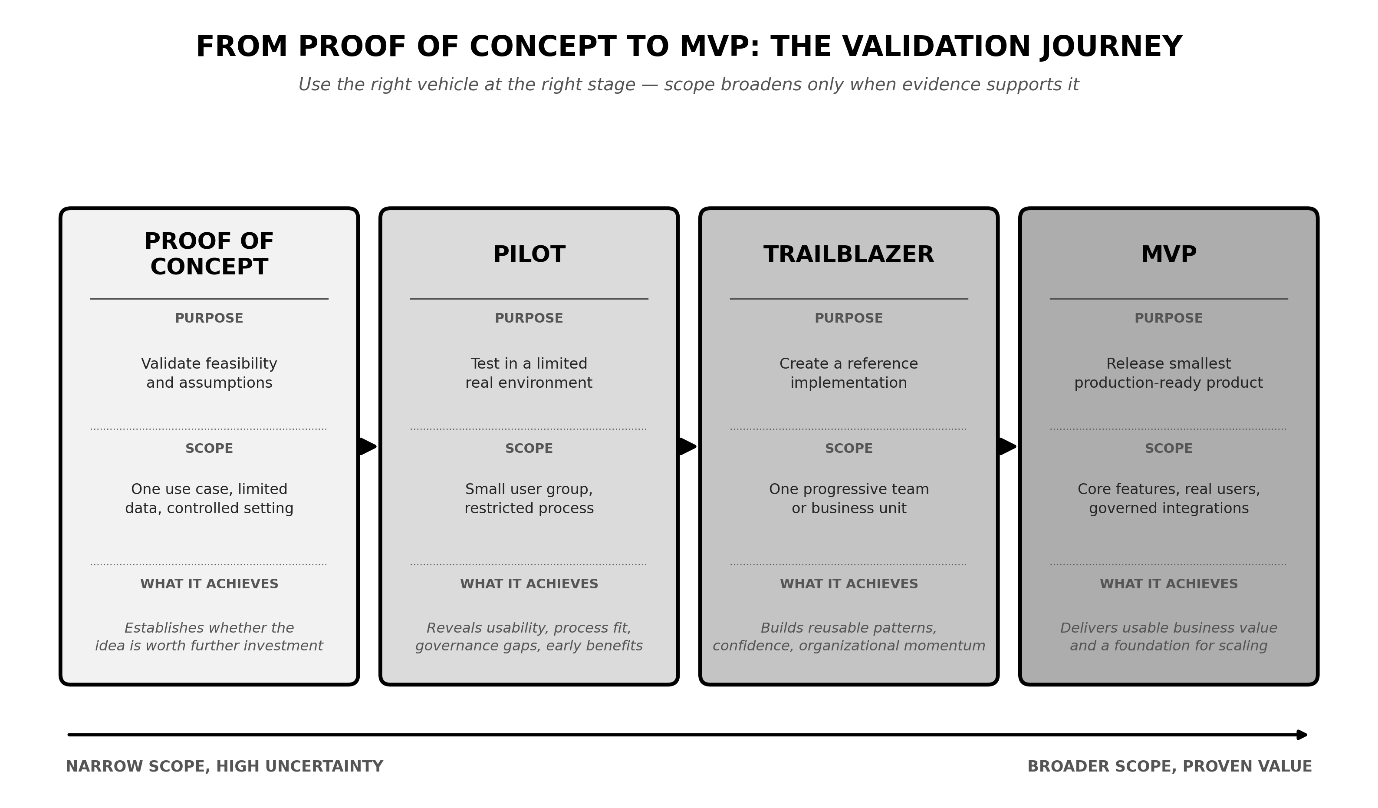
An MVP is the smallest usable version of the solution that can be released to real users with sufficient reliability, security, observability, and support. It is not a rough demo. It is a deliberately limited product that solves a real business problem and creates learning through usage. In AI agent implementation, an MVP may include one or two agentic workflows, defined user roles, approved system integrations, audit logging, human-in-the-loop controls, basic monitoring, and measurable success criteria.
PoC, Pilot, Trailblazer, and MVP Compared
| Construct | Primary Purpose | Typical Scope | Key Limitation | What It Achieves |
| Proof of Concept | Validate feasibility and assumptions. | One use case, limited data, controlled setting. | Does not prove operational readiness or adoption. | Establishes whether the idea is worth further investment. |
| Pilot | Test the solution in a limited real environment. | Small user group, restricted process, defined timeline. | May still depend on manual support and limited scale. | Reveals usability, process fit, governance gaps, and early benefits. |
| Trailblazer | Create a reference implementation for wider adoption. | One progressive team or business unit acting as an adoption leader. | May not represent all enterprise variations. | Builds reusable patterns, confidence, and organizational momentum. |
| MVP | Release the smallest production-ready product that delivers value. | Core features, real users, governed integrations, measurable outcomes. | Does not include every advanced feature or future enhancement. | Delivers usable business value and a foundation for scaling. |
Developing AI agents responsibly requires more than enthusiasm for new technology. It requires a disciplined progression from feasibility to adoption, from adoption to repeatability, and from repeatability to production value.
When to Develop a Proof of Concept
A PoC should be developed when the organization is still uncertain about the technical viability of the idea. This is common when the agent needs to combine reasoning, retrieval, tool execution, workflow orchestration, or enterprise data access in a way that has not been tested before. The PoC is useful when the main question is not, “How do we scale this?” but rather, “Can this be done safely and credibly at all?”
For example, a bank may build a PoC for an AI loan assistant that answers policy questions through retrieval-augmented generation and uses tool calling to create a draft loan application. The PoC may use synthetic or masked data, a limited set of policy documents, and a sandbox workflow. Its purpose is to validate whether the agent can follow the lending policy, retrieve relevant clauses, maintain role-aware access, and stop before final approval. The limitation is clear: such a PoC does not prove that the agent is ready for branch-wide or customer-facing use.
In healthcare, a PoC may test whether a clinical support agent can summarize a patient case from structured and unstructured inputs and retrieve relevant clinical guidelines. The expected achievement is a technical confidence signal: the team learns whether the knowledge source is sufficient, whether the response quality is acceptable, whether privacy boundaries can be respected, and whether a human review gate can be enforced before any recommendation enters clinical workflow.
When to Develop a Pilot
A Pilot is appropriate when the PoC has shown enough promise and the organization wants to understand practical adoption, process impact, exception handling, and operational risk. Unlike a PoC, a pilot must expose the solution to real users, real work patterns, and a limited but authentic business environment. The goal is to see whether the agent improves the work without creating unacceptable risk or excessive operational dependency.
In insurance, a pilot could involve a claims triage agent used by a small team of claims adjusters. The agent may read claim documents, classify the claim type, flag missing documents, suggest next best actions, and prepare a draft response for human review. The pilot’s significance extends beyond the agent’s ability to provide a quality response. The real learning comes from observing how adjusters trust or challenge the output, how often the agent escalates, whether audit trails are complete, and whether cycle time improves for selected claim categories.
In manufacturing, a pilot may deploy a predictive maintenance agent on one production line. The agent may analyze sensor readings, maintenance logs, and equipment manuals to recommend inspection actions. The pilot helps the plant team understand false alarms, technician acceptance, integration with maintenance systems, and downtime reduction potential. It also exposes practical constraints such as noisy sensor data, missing asset history, and limited connectivity on the shop floor.
When to Develop a Trailblazer
A Trailblazer is useful when the organization needs more than technical validation and wants to create a model for repeatable adoption. It is often selected when a business unit has strong leadership sponsorship, motivated users, measurable delivery pain, and readiness to co-create new ways of working. The trailblazer does not try to cover every part of the enterprise. Instead, it proves that one team can operate differently and produce a pattern others can follow.
In retail, a trailblazer could be an e-commerce operations team that adopts a set of AI agents for product content enrichment, inventory exception analysis, customer query summarization, and promotion performance review. The team does not merely use the agents; it documents reusable prompts, defines approval checkpoints, measures productivity, tracks quality feedback, and establishes a pattern for other categories or regions. The achievement is organizational learning: the enterprise gains a living example of how AI agents can be embedded into day-to-day work.
In banking technology modernization, a trailblazer team may automate a repeatable engineering workflow such as vulnerability remediation, Java upgrade, or application migration. The AI agent sequence could read a work item, qualify the story, inspect the repository, recommend an archetype, generate code changes, run validation, create a pull request, and pause for human review before promotion. Such a trailblazer creates reusable implementation playbooks, not just a one-time success story.
When to Develop an MVP
An MVP should be developed when the organization is ready to release a constrained but production-usable solution. By this stage, feasibility has been validated, the pilot has produced learning, and the business case is sufficiently clear. The MVP must include enough functionality to deliver value, but it should avoid unnecessary scope expansion. Its strength lies in disciplined restraint. The team chooses the smallest set of features that solves a real problem and can be operated responsibly.
For a healthcare provider, an MVP may be a patient follow-up agent that reviews discharge instructions, answers routine questions from approved content, reminds patients about medication schedules, and escalates concerning symptoms to a nurse. The MVP would not diagnose disease, prescribe medication, or replace clinical judgment. It would do a narrow job safely: improve follow-up communication, reduce avoidable calls, and create timely escalation signals.
For retail, an MVP could be a store operations agent that helps managers identify stock-out risks, generate replenishment suggestions, and summarize supplier delays. It might be connected to vendor updates, inventory data, and standard operating processes, but human approval of supplier fines or buy modifications might still be required. What the business gains is a working product that reduces manual analysis while retaining management control over commercial decisions.
Industry Examples for AI Agent Implementation
| Industry | PoC Example | Pilot Example | Trailblazer Example | MVP Example |
| Banking | Loan policy assistant using RAG and tool calling in sandbox. | Branch-limited loan application assistant with officer review. | Reusable agent playbook for lending or technology modernization teams. | Production-ready loan status and document assistance agent with approvals retained by staff. |
| Insurance | Claims document summarizer using sample policies and forms. | Claims triage assistant for one product line and adjuster group. | Reference claims automation pattern for multiple regions. | Claims intake and missing-document assistant integrated with claim workflow. |
| Retail | Product content enrichment agent for a limited catalogue. | Inventory exception assistant for selected stores or categories. | E-commerce operations team proving reusable agent-led category management. | Store operations agent for stock-out alerts and replenishment suggestions. |
| Manufacturing | Maintenance recommendation agent using limited sensor and manual data. | Predictive maintenance agent on one production line. | Smart factory reference cell using agents for quality, maintenance, and planning. | Equipment health assistant integrated with maintenance ticketing and escalation. |
| Healthcare | Clinical guideline summarizer using approved non-patient data. | Care coordinator assistant for one clinic or patient cohort. | Digital care team proving safe, human-supervised agent workflows. | Patient follow-up assistant with escalation to nurses and strict clinical boundaries. |
What We Achieve at Each Stage
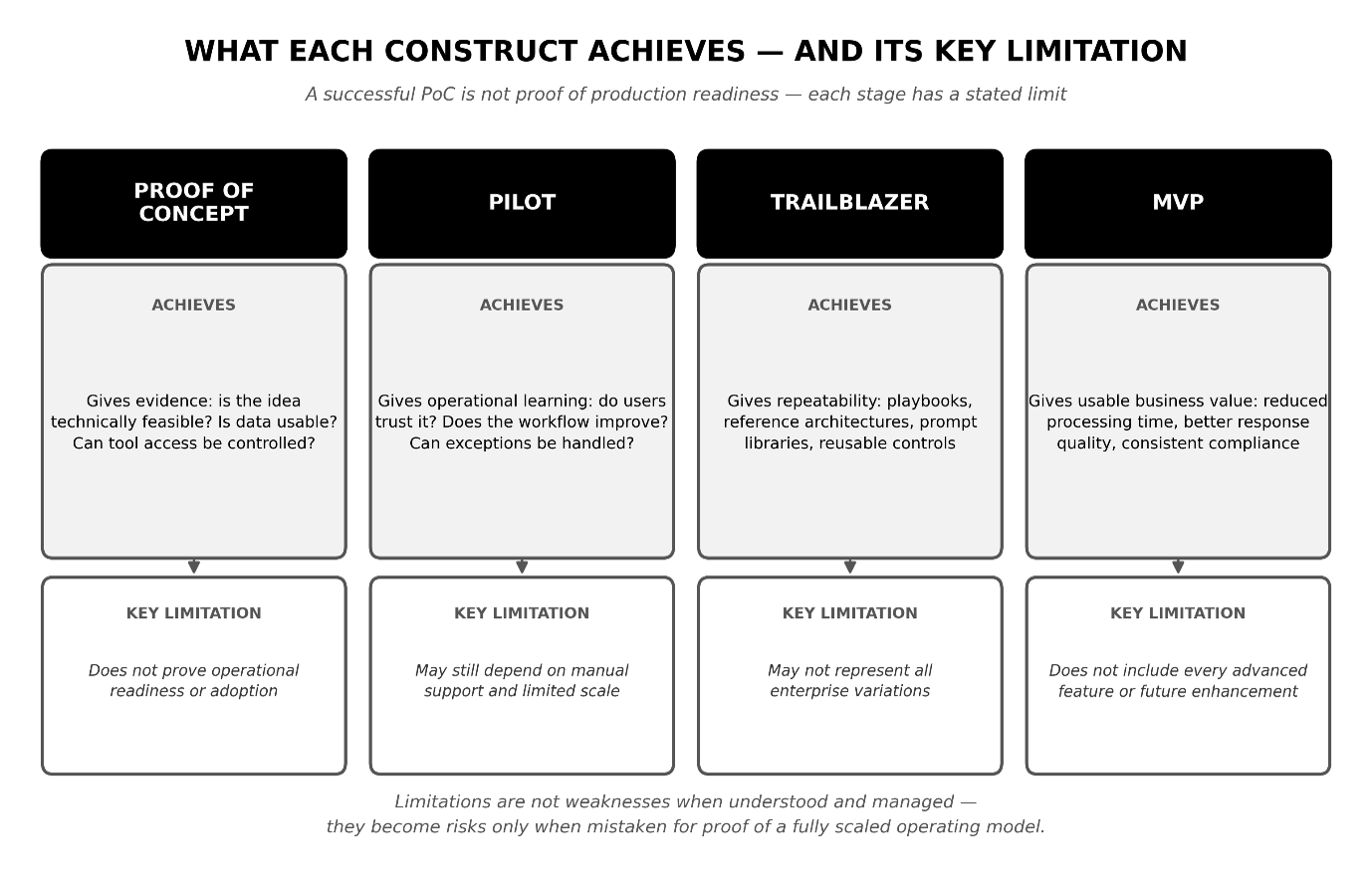
The PoC gives evidence. It helps the team decide whether the agentic idea is technically feasible, whether the data is usable, whether retrieval quality is acceptable, whether the model can follow the intended task, and whether tool access can be controlled. It also exposes early risks such as hallucination, weak grounding, poor data quality, latency, and unclear ownership.
The Pilot provides operational learning. It shows whether users understand the agent, whether they trust the recommendations, whether the workflow improves measurably, and whether exceptions can be handled without creating confusion. It also helps refine onboarding, training, user experience, support procedures, and governance checkpoints.
The Trailblazer gives repeatability. It transforms early success into a pattern that can be reused by other teams. The most valuable outputs are not only agent features, but also playbooks, reference architectures, prompt libraries, adoption metrics, reusable controls, and stories that help other stakeholders understand what good implementation looks like.
The MVP gives usable business value. It proves that the organization can release an AI agent capability into real usage with sufficient controls. It creates measurable outcomes such as reduced processing time, better first-level response quality, fewer manual checks, improved user experience, faster exception detection, or more consistent compliance handling.
Scope and Limitation Considerations
The scope of an AI agent initiative should be intentionally narrow at the beginning and broaden only when evidence supports the next step. A common mistake is to treat a successful PoC as proof of production readiness. In reality, production readiness requires much more: identity management, role-based access, secure tool invocation, observability, cost monitoring, exception handling, test coverage, human review points, rollback procedures, and ownership for continuous improvement.
Limitations should be stated openly. A PoC may not use full production data. A pilot may not represent all user segments. A trailblazer may depend on an unusually motivated team. An MVP may deliberately leave out advanced analytics, full automation, or enterprise-wide integration. These limitations are not weaknesses if they are understood and managed. They become risks only when stakeholders mistake a limited validation exercise for a fully scaled operating model.
Governance for AI Agent Validation
AI agents differ from conventional automation in that they can make decisions, select tools, produce actions, and adjust to circumstances. Governance by design is therefore necessary at every stage of growth. The team should define what the agent can do autonomously, what requires approval, what is prohibited, and how every action will be logged. Sensitive actions such as approving a loan, denying a claim, changing a medical recommendation, releasing a payment, or promoting code to production should remain under explicit human control unless the organization has completed rigorous risk, legal, compliance, and operational reviews.
A practical governance checklist should include data boundary definition, model and prompt versioning, approved knowledge sources, tool permission rules, audit logging, human-in-the-loop points, red-team testing, exception handling, user training, cost thresholds, monitoring dashboards, and periodic review of outcomes. These controls help the organization move faster without losing accountability.
Strategic Decision-Making
Strategic decision-making should begin with the business decision or workflow to be improved—not with the model or platform. Leaders should assess expected value, decision criticality, data readiness, regulatory exposure, integration complexity, and the consequences of incorrect or unauthorized actions. Each use case should then be placed on an autonomy spectrum: assist, recommend, act with approval, or act autonomously within defined limits. High-impact decisions, including lending, claims denial, clinical recommendations, payments, and production releases, should retain explicit human accountability.
Investment should advance through evidence-based gates. A PoC must demonstrate feasibility and grounding; a Pilot must establish operational fit and user trust; a Trailblazer must prove repeatability; and an MVP must deliver measurable value with production-grade controls. Decision criteria should include quality, cycle-time improvement, adoption, exception rates, security, cost per task, auditability, and residual risk. This approach reflects current emphasis on lifecycle risk management, secure agent identity, authorization, and interoperability.
Defining the roadmap for Agent development
The roadmap for AI agent development should provide a controlled path from a promising business idea to a secure, measurable, and scalable production capability. Use-case discovery and prioritization should come first, with an emphasis on workflows with definite business value, adequate data, identified users, and controllable risk. The team should define the expected outcome, baseline performance, decision boundaries, prohibited actions, approved knowledge sources, system integrations, and human-accountability model. The agent’s intended autonomy should also be explicit: whether it will assist, recommend, execute with approval, or act independently within predefined limits.
The PoC stage should validate the most uncertain technical assumptions using controlled data and sandboxed tools. Evaluation should measure grounding, response quality, tool-selection accuracy, task completion, latency, cost, and compliance with instructions. Progression should occur only when predefined thresholds are met and critical failure modes—such as hallucination, unauthorized tool use, prompt injection, or disclosure of sensitive information—are adequately controlled.
The Pilot stage should place the agent in a limited real-world environment with selected users and authentic workflows. Its purpose is to evaluate usability, adoption, process fit, exception handling, integration reliability, and operational benefits. Human overrides, escalation frequency, failed tool calls, user feedback, and business outcomes should be monitored continuously. Pilot evidence should determine whether the solution requires refinement, termination, or further investment.
The Trailblazer stage should convert pilot learning into a repeatable enterprise pattern. The team should create reusable reference architecture, prompt and tool templates, evaluation suites, security controls, governance checklists, operating procedures, training materials, and adoption dashboards. This prevents each business unit from rebuilding the same capabilities and controls independently.
The MVP stage should deliver the smallest production-ready capability that creates measurable value. It should include agent identity, least-privilege access, approved integrations, audit logging, observability, version control, human-in-the-loop checkpoints, incident response, rollback, and accountable business ownership.
After release, scaling should be incremental and evidence-based. Only after proving consistent quality, manageable risk, and favorable commercial results could new workflows, tools, users, or autonomy be added. Continuous evaluation should address model and prompt drift, knowledge freshness, security incidents, cost, user overrides, and changing regulatory requirements. The roadmap is therefore not a one-time sequence, but a governed improvement cycle in which operational evidence continuously informs refinement and expansion.
Conclusion
Developing AI agents responsibly requires more than enthusiasm for new technology. It requires a disciplined progression from feasibility to adoption, from adoption to repeatability, and from repeatability to production value. A PoC answers whether the idea can work. A Pilot shows whether it works in a controlled operational setting. A Trailblazer turns early success into a reusable organizational pattern. An MVP delivers a limited but real product that users can depend on and the business can measure.
For banking, insurance, retail, manufacturing, and healthcare, this progression is especially important because AI agents often touch regulated decisions, customer trust, operational continuity, and sensitive data. The safest path is not to slow innovation, but to structure it. When organizations choose the right validation stage for the right problem, they reduce uncertainty, build confidence, and create AI agent solutions that are not only impressive in demonstrations but also useful, governed, and sustainable in real business environments.